
Tanzania's most overlooked hunter
Ask most travellers to name the cats of a Tanzanian safari and they will stop at three: lion, leopard, cheetah. Yet among the most remarkable serval wildlife Tanzania has to offer is a cat that many visitors drive straight past — a slender, long-legged, satellite-eared hunter of the long grass that happens to be one of the most successful predators in Africa. The serval is not rare, exactly, but it is discreet, and a good sighting is the kind of moment that guides talk about over dinner long after the lions have been forgotten.
This is a species portrait with a practical safari payoff. We will look at what makes the serval such an extraordinary animal — the improbable proportions, the radar-dish ears, the vertical pounce that clears three metres — and then get down to business: where servals live in Tanzania, why the Serengeti's long grass and the Ngorongoro highlands are your best hunting grounds, the strange story of the crater's black servals, and how our guides actually find a cat that is built to be invisible. By the end, you may find the small cats climbing your safari wish list.
Built like no other cat
The serval looks like a cat designed by a committee with a sense of humour, yet every odd proportion is precision engineering. Standing around 60 centimetres at the shoulder but weighing only 9 to 18 kilograms, the serval has the longest legs relative to body size of any cat in the world — stilts that lift its head above the grass and power its famous leaps. The small head, long neck and golden, black-spotted coat complete a silhouette so distinctive that once you have seen one, you will never mistake it for anything else on the plains.
Then there are the ears. Relative to its head, the serval carries the largest ears of any cat — great oval dishes that it swivels independently, like a pair of satellite receivers scanning the grass. A hunting serval barely uses its eyes at all. It stands motionless in the long grass, ears rotating, triangulating the rustle of a rodent it cannot see, sometimes for several minutes at a time. It can detect prey moving underground, and it will pause mid-hunt with one forepaw raised, head cocked, in a pose so intent it looks carved. Sound, not sight, is the serval's weapon.
The three-metre pounce
What follows the listening is the spectacle. Having fixed its target by ear alone, the serval launches itself in a high, arcing vertical pounce — up to three metres into the air and several metres forward — and comes down forepaws-first with pinpoint accuracy on prey it never actually saw. It is one of the most athletic moves in African wildlife, and the same leap serves another trick: servals will spring straight up to swat low-flying birds out of the air, twisting mid-jump like a gymnast. When guides call the serval a supercat, this pounce is exhibit A.
The results are humbling for the big cats. Servals convert roughly half of their hunting attempts into a kill — and at night the success rate can climb higher still — while lions, for all their power and teamwork, succeed perhaps a quarter to a third of the time. A busy serval may catch ten or more rodents in a night, along with frogs, insects, snakes and birds. Pound for pound, this quiet spotted cat of the long grass is one of the most efficient predators in Africa, which is precisely why it thrives in the same landscapes where the glamour species struggle.
Where servals live and hunt
Servals in Africa range across much of the sub-Saharan savannah, but they are specialists, not generalists: they need long grass and they need water. Well-watered grassland, marsh edges, reed beds and moist savannah are their strongholds, because that is where the rodents are, and rodents make up the great bulk of a serval's diet. This is why you will rarely see a serval on bare, overgrazed ground — the habitat that hides its prey is the same habitat that hides the cat, and the two are inseparable.
Servals are solitary and territorial, patrolling home ranges marked with scent, and they are most active at dawn, at dusk and through the night. Happily for safari-goers, Tanzania's cool mornings — particularly in the green season, when the grass is tall and the rodent population booms — often keep servals hunting well after sunrise. That is the window our guides work: early light, long grass, damp ground, and a slow drive with everyone watching for a small head periscoping above the stems.
The black servals of the crater highlands
Tanzania holds one of the most intriguing serval stories in Africa: the melanistic, or black, servals of the Ngorongoro highlands. In the cool, high-altitude moorland and grasslands around the crater — and on the plains of the eastern Serengeti — a proportion of servals carry a genetic variation that turns the familiar spotted gold coat a deep charcoal black. Scientists believe the dark coat may help the cats absorb warmth at altitude, and whatever the reason, a black serval stalking through green highland grass is one of the most striking sights in the country.
These melanistic servals are genuinely rare — even guides who work the crater for years count their black serval sightings on one hand — which makes the Ngorongoro Conservation Area a place of double reward for cat enthusiasts. On the crater floor and the surrounding highlands you have some of the best ordinary serval viewing in Tanzania, with the outside chance of the extraordinary: a coal-black cat that a handful of photographers have made world-famous, in a landscape that already ranks among the most spectacular on earth.
Where in Tanzania your odds are best
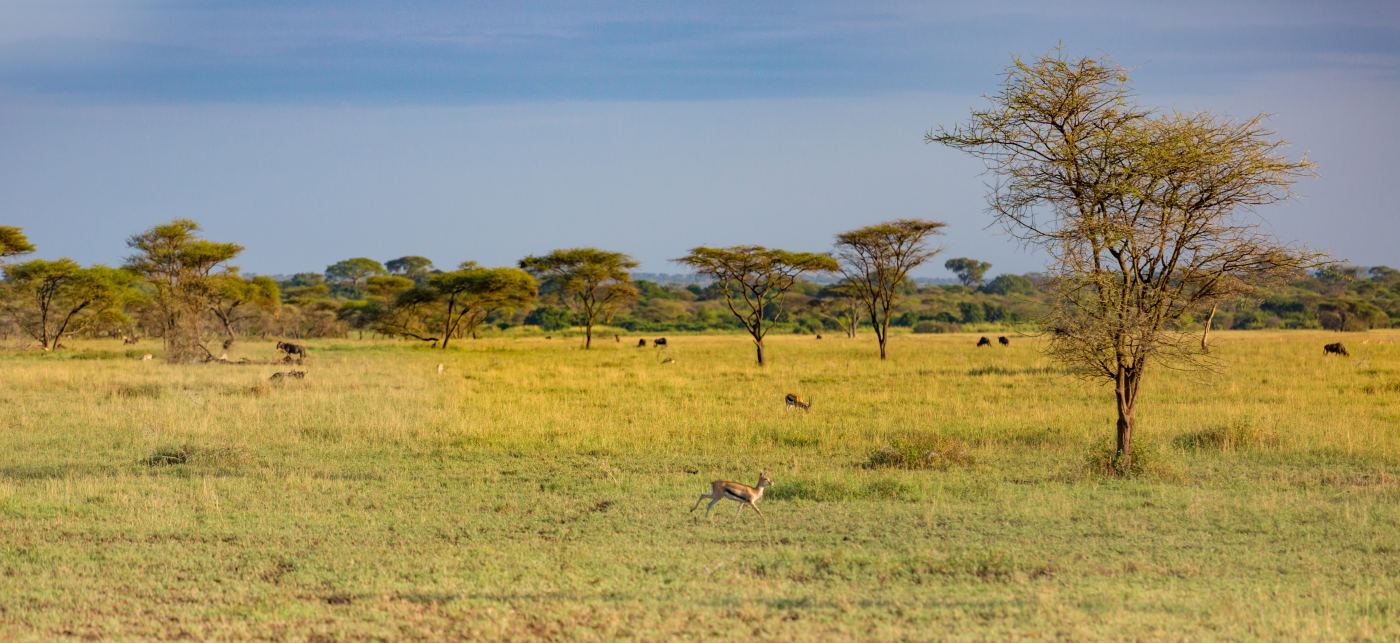
For the serval cat, Tanzania's northern circuit is the happy hunting ground, and two areas stand clearly above the rest. The first is the Serengeti, particularly its long-grass plains and marshy drainage lines: the eastern plains around the Namiri area, the Seronera valley's watercourses, and the green-season grasslands of the south all produce regular sightings. The second is Ngorongoro — both the crater floor, where the grass, marshes and rodents concentrate in one amphitheatre, and the highland slopes with their melanistic celebrities.
Timing tilts the odds further. The green season, from roughly November to May, brings tall grass and an explosion of rodents, and servals respond by hunting busily through the cool, overcast mornings — some of our best sightings come in April and May, when the plains are quiet of vehicles and loud with life. In the dry season the grass burns down and shortens, which paradoxically can make the cats easier to see when they do move, particularly along the marsh edges and river margins where the last green cover holds the last rodents.
Any good Tanzania wildlife safari through the north gives you serval chances without changing the itinerary at all — the classic Serengeti and Ngorongoro route passes straight through the best habitat in the country. The difference between driving past a serval and watching one hunt is rarely the route; it is the pace, the guide and whether anyone in the vehicle has told the guide that the small cats matter to them. Which brings us to how these cats are actually found.
How guides find a cat built to vanish
Spotting a serval is a craft. The cat is grass-coloured, grass-sized and silent, so our guides hunt for anomalies rather than animals: two black-backed ears above the seed heads, a head raised briefly to periscope, the shiver of stems moving against the wind, or the sudden vertical flash of a pounce in the middle distance. They also read the ground — marsh edges, drainage lines and rain-soaked grassland after a storm are checked slowly and deliberately, because experience says that is where a hunting serval will be working.
The other half of the craft is patience. A serval that drops out of sight in long grass has not gone; it is listening, and a guide who switches off the engine and waits will very often be rewarded with the leap. The best sightings unfold over twenty unhurried minutes — the stalk, the frozen listening pose, the pounce, the toss of a caught rat — and they simply do not happen to vehicles racing between lion prides. Guides love servals precisely because they reward fieldcraft over luck, and a guest who wants one gives the guide licence to slow down.
Meet the rest of the cast in our guide to the animals of the Serengeti, see how a full Tanzania wildlife safari comes together, compare the icons in the Big 5, or browse our safari packages.
Lions succeed on perhaps a quarter of their hunts. The serval, alone in the long grass with nothing but its ears, succeeds on half.
- Longest legs relative to body of any cat
- Largest ears relative to head — it hunts by sound alone
- Vertical pounce of up to three metres
- Roughly 50 percent hunting success — far better than lions
- Best areas: Serengeti long grass and Ngorongoro
- Rare melanistic (black) servals in the crater highlands
The wider small-cat cast
Once the serval has opened your eyes, Tanzania's supporting cast of cats gets richer still. The caracal — muscular, rufous, with extravagant black ear tufts — favours drier, scrubbier country than the serval and is an even scarcer prize, famous for leaping to snatch birds from the air. The African wildcat, ancestor of every housecat on earth, slips through the grass at dawn looking teasingly familiar until you notice the longer legs and the reddish backs of its ears. Both turn up across the northern parks for those who look.
Seen together, the small cats reframe the whole safari. The Big 5 and the great predators supply the drama, but the servals, caracals and wildcats supply the depth — proof that the plains are layered with hunters at every scale, each solving the same problem in a different way. Seasoned safari-goers often say their trips changed the day they stopped counting lions and started reading the grass, and in Tanzania the serval is usually the cat that teaches that lesson first.
Why a serval sighting feels special
Part of it is scarcity of attention rather than scarcity of cats: servals are simply missed, so a good sighting feels earned in a way a lion at a kill, ringed by vehicles, sometimes does not. Part of it is the performance — few moments on safari match the coiled stillness of the listening pose breaking into that impossible three-metre arc. And part of it is intimacy. Serval sightings are usually yours alone, one vehicle, engine off, grass hissing in the wind, watching a small perfect predator work a marsh edge as if you were not there at all.
At Sokwe Africa Safaris we plan for these moments deliberately. Itineraries that linger in long-grass country at the right hour, guides briefed that you care about more than the icons, and the unhurried pace that lets a stalk play out — that is what converts serval habitat into serval memories. The cat does the rest, as it has for a few million years, ears turning above the grass of the Serengeti and the crater floor.
Tell us you want the small cats
Our guides keep a mental map of serval territories — the marsh edges, drainage lines and long-grass flats where the cats hunt season by season — and the single best thing you can do is tell us, before you travel, that the small cats matter to you. We will build your Serengeti and Ngorongoro days around the right habitat at the right hours, slow down where it counts, and give you an honest shot at the listening pose, the pounce, and perhaps even a black serval in the highlands. Tell us what you want to see, and we will design the safari that finds it.
Plan your Tanzania wildlife safari with Sokwe Africa Safaris