
The reputation, and why it is wrong
Almost every guest who comes on safari arrives with an opinion about hyena, and almost all of those opinions are inherited from film rather than from the field. The spotted hyena is imagined as a cowardly scavenger, skulking at the edges of a lion kill, waiting for scraps. It is one of the most thoroughly inaccurate pieces of received wisdom in African wildlife, and correcting it is one of the quiet pleasures of guiding.
Spotted hyena hunt for the majority of what they eat. Depending on the study and the region, somewhere between sixty and ninety-five per cent of a clan's food is killed by the clan itself. In the Serengeti ecosystem the figure sits at the higher end of that range. They are, by a considerable margin, the most numerous large carnivore in Tanzania, and in terms of biomass consumed they outweigh lion, leopard and cheetah combined.
The relationship with lion runs the other way rather more often than people expect. Lion routinely appropriate hyena kills, using their size advantage to displace a clan from a carcass the clan brought down. Watch carefully at a contested kill and you will frequently see a large number of hyena that killed the animal, and a small number of lion now eating it. The narrative has simply been told backwards.
How a clan actually works
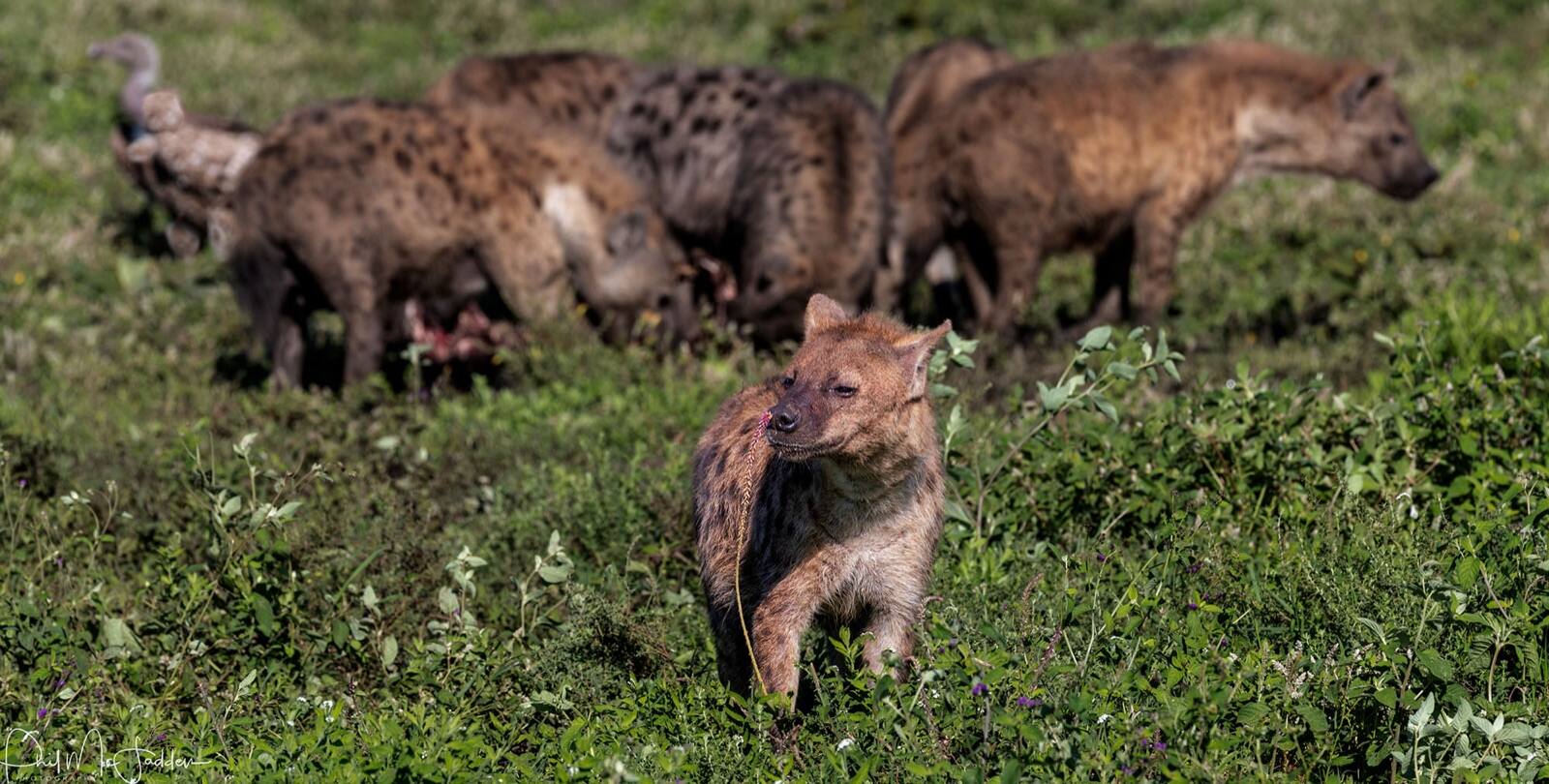
Spotted hyena live in clans that can number from a handful of animals to eighty or more, and those clans are matriarchal in a way that is genuinely unusual among mammals. Females are larger than males, dominant to all of them, and a clan is led by a single matriarch whose daughters inherit rank directly below her. A male entering a new clan starts at the very bottom of the hierarchy regardless of his size or age.
Rank in a hyena clan is inherited rather than fought for, and it is remarkably stable. The cubs of a high-ranking female eat before adult males do. This has real consequences on the ground: a low-ranking animal at a carcass may get very little, which is why the noise around a kill is so extraordinary. What sounds like chaos is in fact a rapid, well-understood negotiation about who eats in what order.
Clans hold and defend territory, and they mark and patrol its boundaries. In the Serengeti, where the prey base moves with the migration, some clans commute considerable distances from a fixed den to wherever the herds currently are, then return. Hyena have been recorded travelling eighty kilometres round trip to feed and come back to nurse cubs at the den.
The den, and why you should ask to visit one
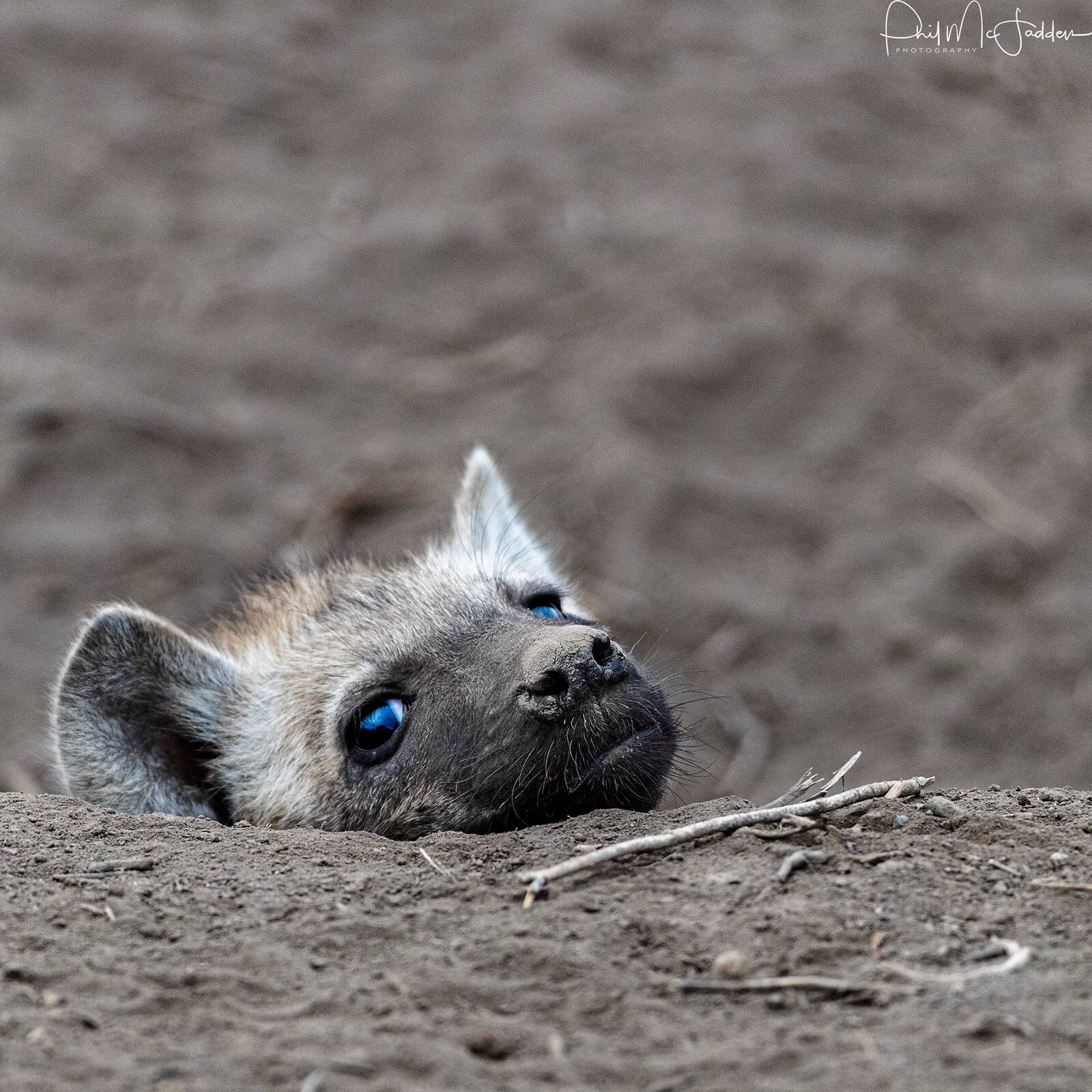
If you have any interest in animal behaviour, an hour parked at a hyena den will give you more than almost anything else on a Tanzanian safari. Dens are communal, usually an old aardvark burrow enlarged over years, and they hold cubs of several different mothers and ages. The tunnels are too narrow for an adult, which is exactly the point — they protect cubs from lion.
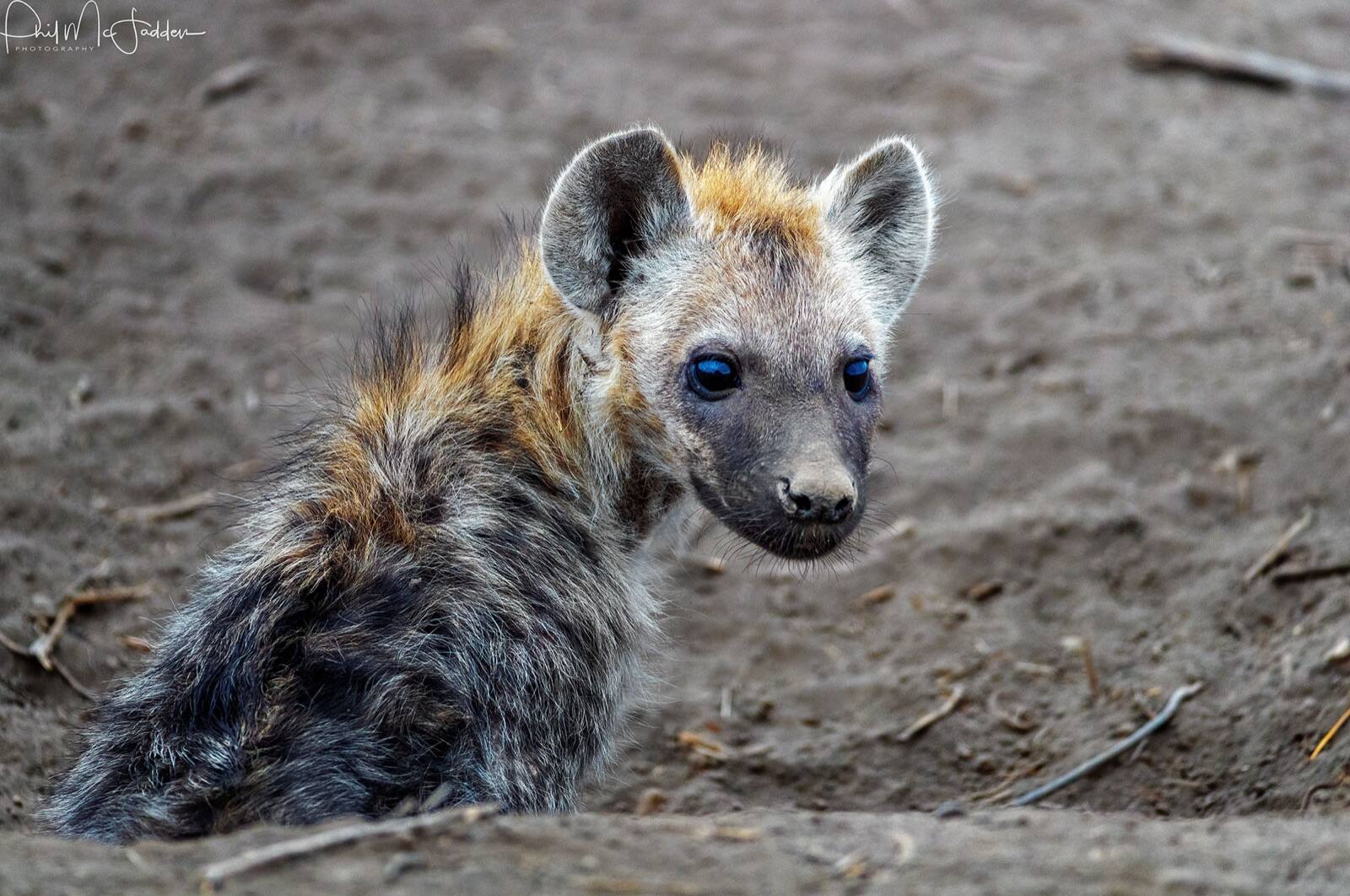
Cubs are born black and change to the spotted coat over several months. They are also born with their eyes open and their front teeth already erupted, which is unusual and occasionally consequential: siblings establish dominance within days of birth, sometimes fatally. It is uncomfortable to describe and remarkable to watch.
What guests most often remark on is how playful a den is. Cubs wrestle, chase, chew on everything, and pester adults who tolerate an extraordinary amount of it. The gap between this and the animal's reputation is so wide that it tends to change people's minds in a single sitting. We build time for it into itineraries when we know a den is active.
The sounds, and how to read them
Spotted hyena have one of the most varied vocal repertoires of any African mammal, and learning three or four of the calls transforms a night under canvas from unsettling into interesting. The famous whoop is a long-distance contact call — a rising note that carries five kilometres and lets clan members locate one another across the plain.
The giggle, which gave the animal its "laughing hyena" name, is not amusement. It is a sound of stress and social subordination, usually produced by a lower-ranking animal under pressure at a carcass or being harassed. When you hear giggling at night, something is being contested nearby.
There is also a low groaning and a sharp alarm rumble, and the whole vocabulary is used constantly. Ask your guide to identify what you are hearing when you sit outside camp after dinner. Sound is a large part of the East African night and most guests spend a week without anyone explaining it to them.
Predator viewing is at its best during the calving months — see the Ndutu calving season and our guide to the Big Five.
Where to see hyena in Tanzania
Hyena are found across the whole northern circuit and you will not need to search for them. The Ngorongoro Crater holds a famously dense population in a confined area, and the interactions between crater lion and crater hyena are among the best-documented in Africa. Because the crater floor is open and the sightlines are long, it is the easiest place to watch a hunt develop from beginning to end.
The Serengeti plains, particularly around Ndutu during the calving season from January to March, concentrate hyena in very large numbers. With hundreds of thousands of vulnerable wildebeest calves on open ground, this is the period of greatest predator activity anywhere in Tanzania, and hyena take full advantage of it.
Tarangire and Lake Manyara both hold hyena, though at lower density and in more wooded country where sightings are less frequent. If hyena behaviour genuinely interests you, the crater and the southern Serengeti plains are where to spend your time.
Hyena and lion: the oldest argument on the plains
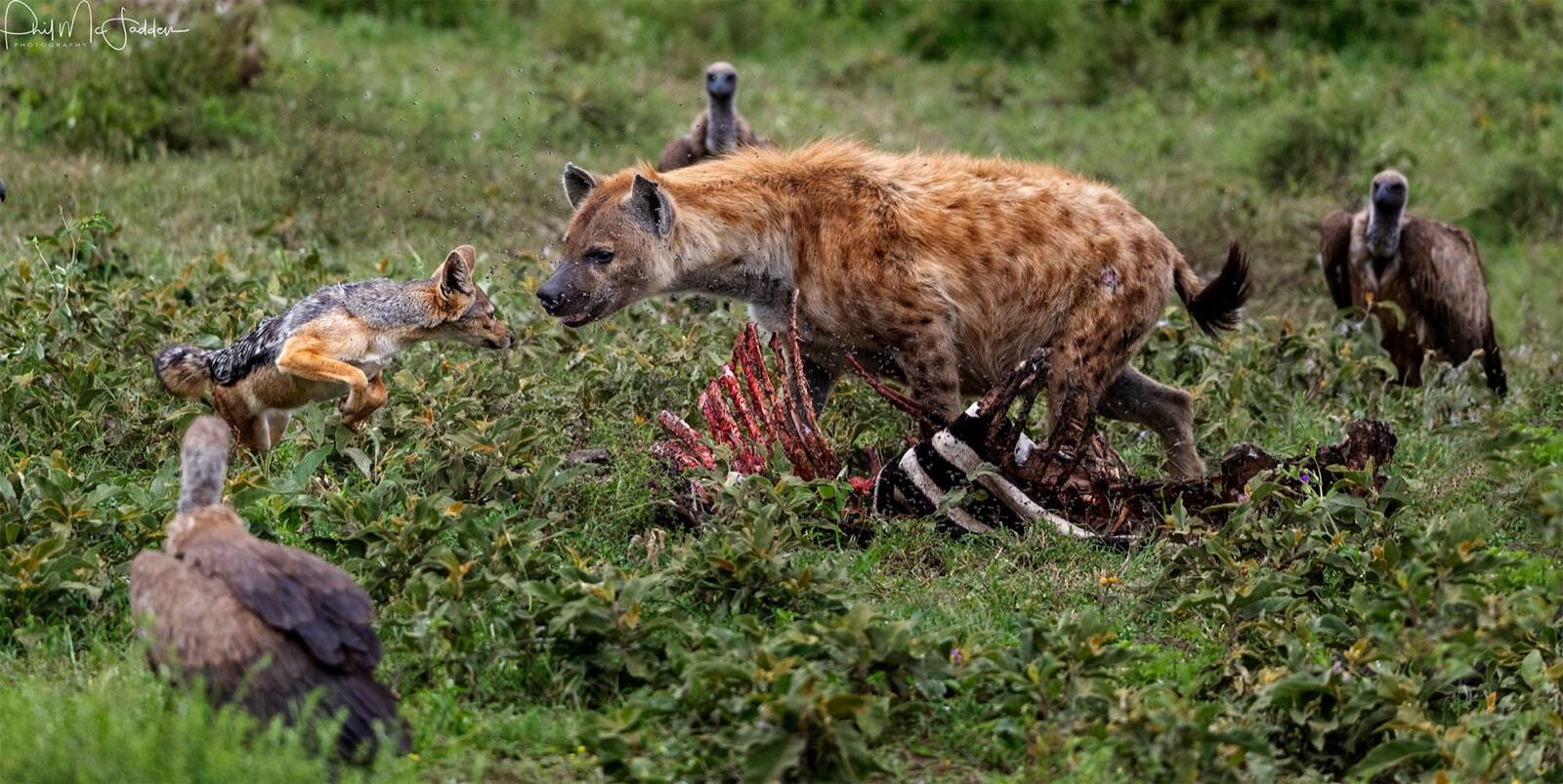
The relationship between spotted hyena and lion is the defining rivalry of the East African savannah, and it is far more even than most people assume. The two species compete for exactly the same prey across exactly the same ground, and they kill one another's young whenever the opportunity arises. Lion will go out of their way to find and destroy a hyena den. Hyena will kill unguarded lion cubs. This is not opportunism at the margins; it is a sustained, mutual campaign that shapes where both species can successfully raise offspring.
At a carcass the outcome comes down to arithmetic. Researchers in the Ngorongoro Crater and the Serengeti have documented the ratio with some precision: a clan generally needs around four hyena for every adult lioness present before it will press a challenge, and the presence of a single adult male lion changes the calculation entirely. A male lion is roughly twice the weight of a hyena and will kill one outright, so clans that will happily mob three lionesses off a kill will hold back and wait when a male arrives.
What this produces, over the course of an evening, is a slow and noisy negotiation rather than a single confrontation. The clan gathers, tests, retreats, gathers again in greater numbers, and the balance tips gradually. Guests who stay with a contested carcass for two or three hours see something far more interesting than a fight — they see two species continuously assessing each other. It is among the best things to watch anywhere in Tanzania, and it happens most reliably at night or in the last hour of light.
Their role in the system
The ecological function of a hyena clan goes well beyond predation. Their jaws generate enough force to process bone that no other African carnivore can consume, and their digestion is capable of breaking down material — including hoof and horn — that would otherwise sit on the plain for months. A hyena clan is the reason the Serengeti is not littered with skeletons.
That bone consumption also cycles calcium and phosphorus back into the soil in a form plants can use. The white droppings you see on the plains are largely bone calcium. It is not a glamorous contribution, but the system would function differently without it, and it is worth knowing that the animal most often described as repulsive is doing a substantial share of the ecosystem's essential work.
Their hunting is also more sophisticated than the reputation allows. A hyena clan hunting wildebeest will test a herd at a run, reading which animals move badly, then commit to one and pursue it for several kilometres at a steady pace rather than a sprint. They are endurance hunters where cheetah are sprinters, and a chase that looks like it has failed after four hundred metres is frequently still in progress twenty minutes later. Their success rate on adult wildebeest is comfortably higher than a lion pride's on the same prey.
They are also, by a wide margin, the most intelligent carnivore most guests will see in Tanzania. Captive studies have shown spotted hyena outperforming chimpanzees on certain cooperative problem-solving tasks, and in the field the evidence is in how precisely they read social situations — recognising individual clan members, tracking who owes whom, and adjusting behaviour at a carcass according to exactly who else is present. Watching a clan work is watching a genuinely complex society operate in real time.
Hyena are not endangered, and populations inside Tanzania's protected areas are healthy. The pressures they face are outside the parks, where they come into conflict with livestock keepers and are killed in retaliation, and where they are caught in snares set for other animals. As with most Tanzanian wildlife, the protected areas are working; the edges are where the difficulty lies.
See them properly
If animal behaviour interests you more than a checklist of species, tell us. We will put you with a guide who enjoys explaining what you are watching, build in the long stationary hours that behaviour actually requires, and take you to the crater and the southern plains where hyena are easiest to observe at length.
Plan your safari with Sokwe Africa Safari
Frequently asked questions
Are hyenas scavengers or hunters?
Primarily hunters. Depending on the region, sixty to ninety-five per cent of what a spotted hyena clan eats is killed by the clan itself, and in the Serengeti the figure sits at the higher end. Lion steal from hyena more often than the reverse.
Are female hyenas really dominant?
Yes. Spotted hyena clans are matriarchal, females are larger than males, and every female outranks every male. Rank is inherited from the mother rather than won by fighting, and a male joining a new clan starts at the bottom.
Where is the best place to see hyena in Tanzania?
The Ngorongoro Crater, which holds a dense population in open country with long sightlines, and the southern Serengeti plains around Ndutu during the January to March calving season when predator activity peaks.
Why do hyenas laugh?
The giggle is not amusement. It is a stress and subordination call, usually made by a lower-ranking animal under pressure at a carcass. The long rising whoop is the contact call that carries several kilometres.
Are hyenas dangerous to humans?
Attacks are rare and almost always involve people sleeping in the open outside a tent. Standard camp practice — staying inside your tent at night and being escorted after dark — reduces the risk to negligible.
Can you visit a hyena den on safari?
Often yes, when a den is active near your route. It is one of the best behavioural sightings available in Tanzania and we will build time for it into an itinerary if we know of one. Vehicles keep their distance so the clan is not disturbed.