
The greatest show on Earth
The wildebeest migration is not a single event but a permanent, restless circle — roughly 1.5 million wildebeest, joined by several hundred thousand zebra and gazelle, moving through the Serengeti-Mara ecosystem in an endless clockwise loop that never truly begins and never ends. It is the largest overland movement of mammals left on the planet, and unlike almost everything marketed as a spectacle, it lives up to the billing. But it is far more than a river crossing on a documentary: it is a piece of ecological machinery, driven by rain, grass and hunger, and understanding how it works transforms what you see from a stampede into a story.
Most articles about the great wildebeest migration are really trip-planning guides, and there is nothing wrong with that — we have written one ourselves. This piece is different. Here we set out to explain the phenomenon itself: what a wildebeest actually is, why a million and a half of them walk in circles forever, how the annual cycle unfolds, who travels with them and who preys on them, and why the whole system is more fragile than it looks. Only at the end do we turn to how you might witness each chapter for yourself.
What exactly is a wildebeest?
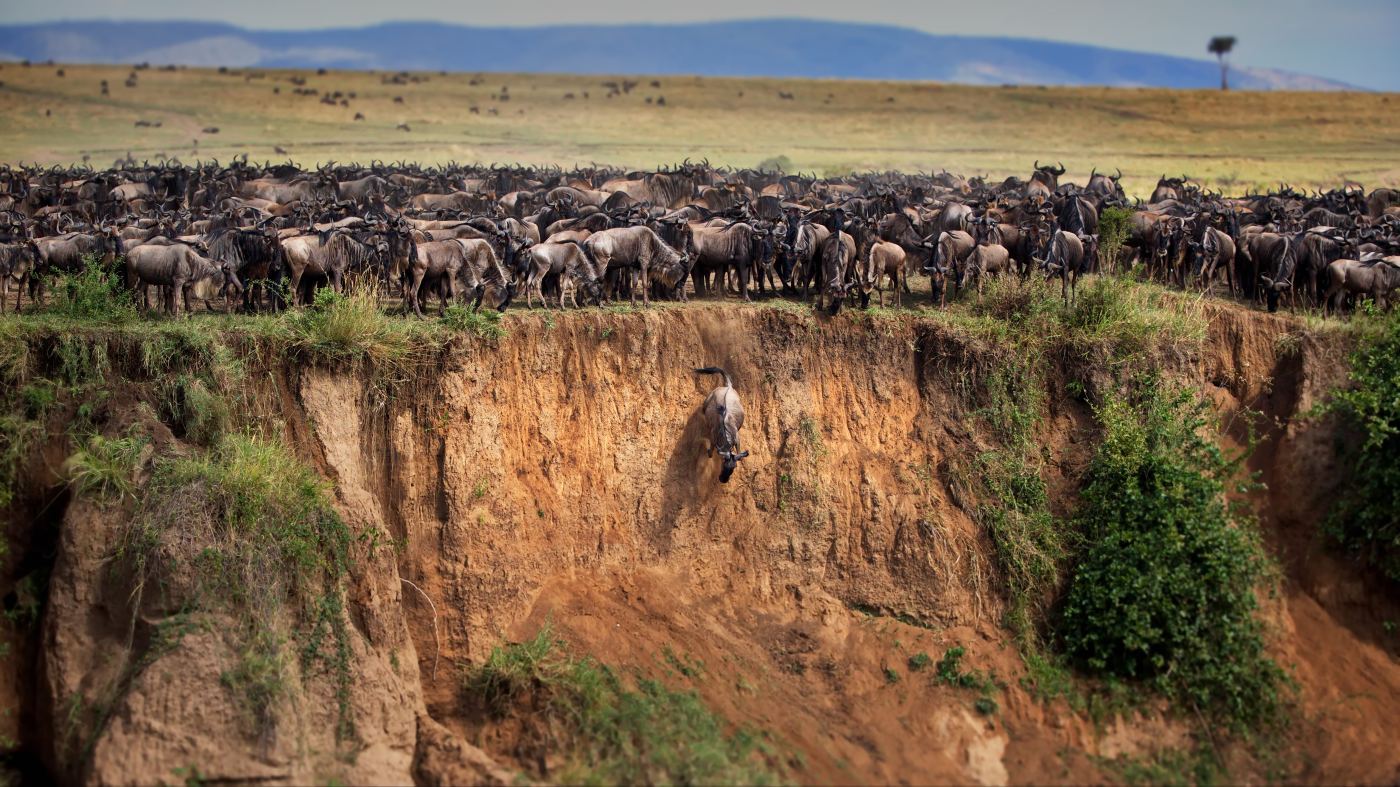
The wildebeest, or blue wildebeest, is one of nature's great underdogs. At first glance it looks like a committee-designed animal — the head and horns of a buffalo, the mane and tail of a horse, the sloping back of a hyena and the beard of a goat. Yet this ungainly antelope is one of the most successful large herbivores on the continent, and the entire Serengeti ecosystem is, in a very real sense, built around its appetite and its restlessness.
What makes the wildebeest special is not beauty but design for a purpose. It is a grazing machine, engineered to crop short grass efficiently, to walk enormous distances on modest energy, and to breed with astonishing synchrony. It belongs to a herd that behaves less like a crowd of individuals than a single, spread-out organism responding to the same signals of rain and grass. Underestimate the wildebeest and you miss the point of the whole migration.
Why they move: rain, grass and chemistry
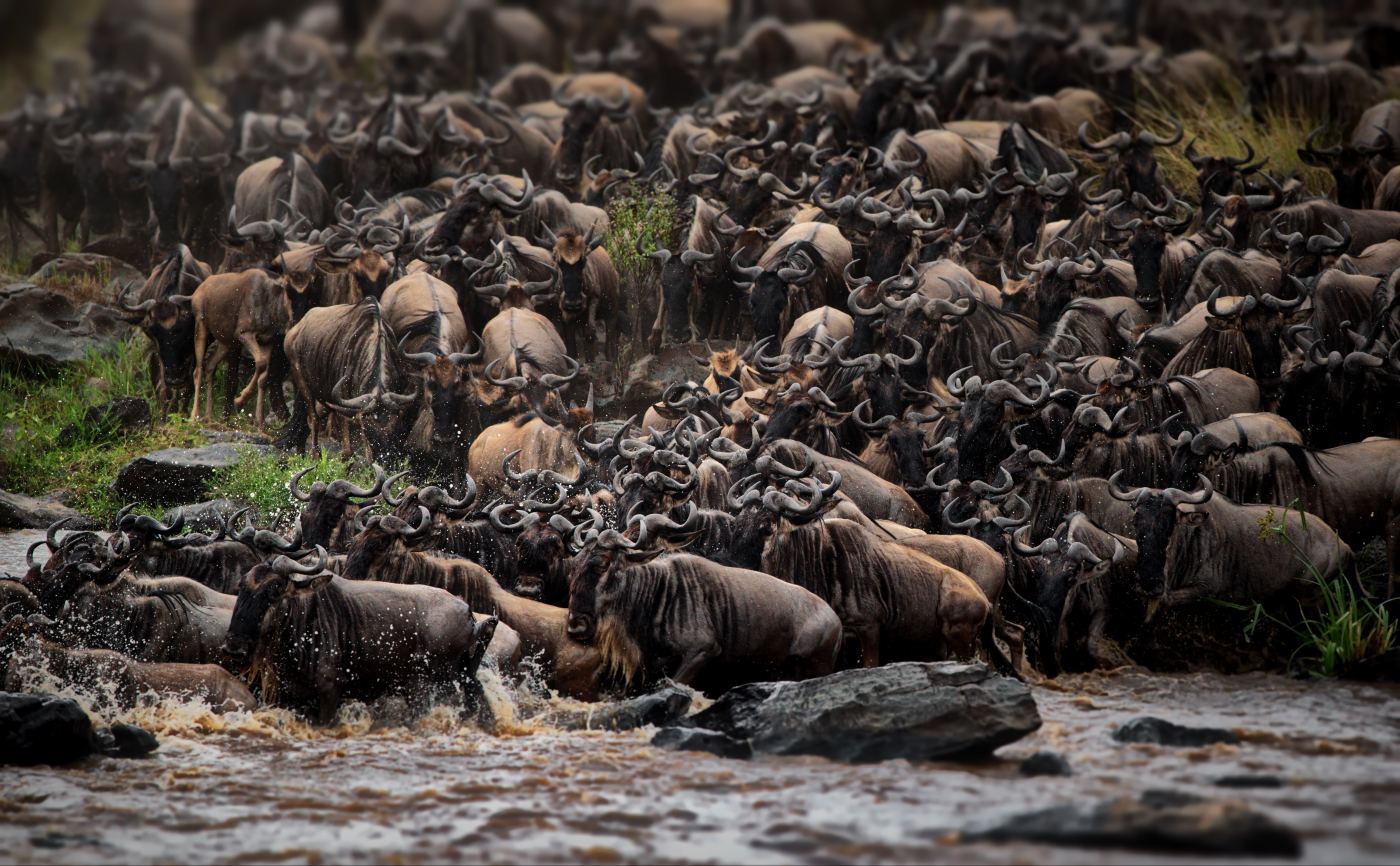
The single question everyone asks is why. Why walk in circles at all? The short answer is grass, and the longer answer is chemistry. Wildebeest are followers of rain, and the rain in the Serengeti-Mara ecosystem falls in a predictable seasonal pattern that pulls fresh, green grazing across the landscape month by month. The herds simply chase the newest grass, because young growth is far richer in protein and lower in indigestible fibre than mature, dried-out pasture. The migration is 1.5 million animals following a moving buffet.
The chemistry runs deeper than freshness alone. The short-grass plains of the southern Serengeti and Ndutu sit on soils enriched by volcanic ash from the Ngorongoro highlands, unusually high in the calcium and phosphorus that pregnant and lactating wildebeest need. That is why the herds pour south for the calving season even though grazing exists elsewhere — the southern plains are the maternity ward the ecosystem has chemically prepared. Rain sets the timing, grass sets the direction, and mineral-rich soil sets the destination.
The calving explosion
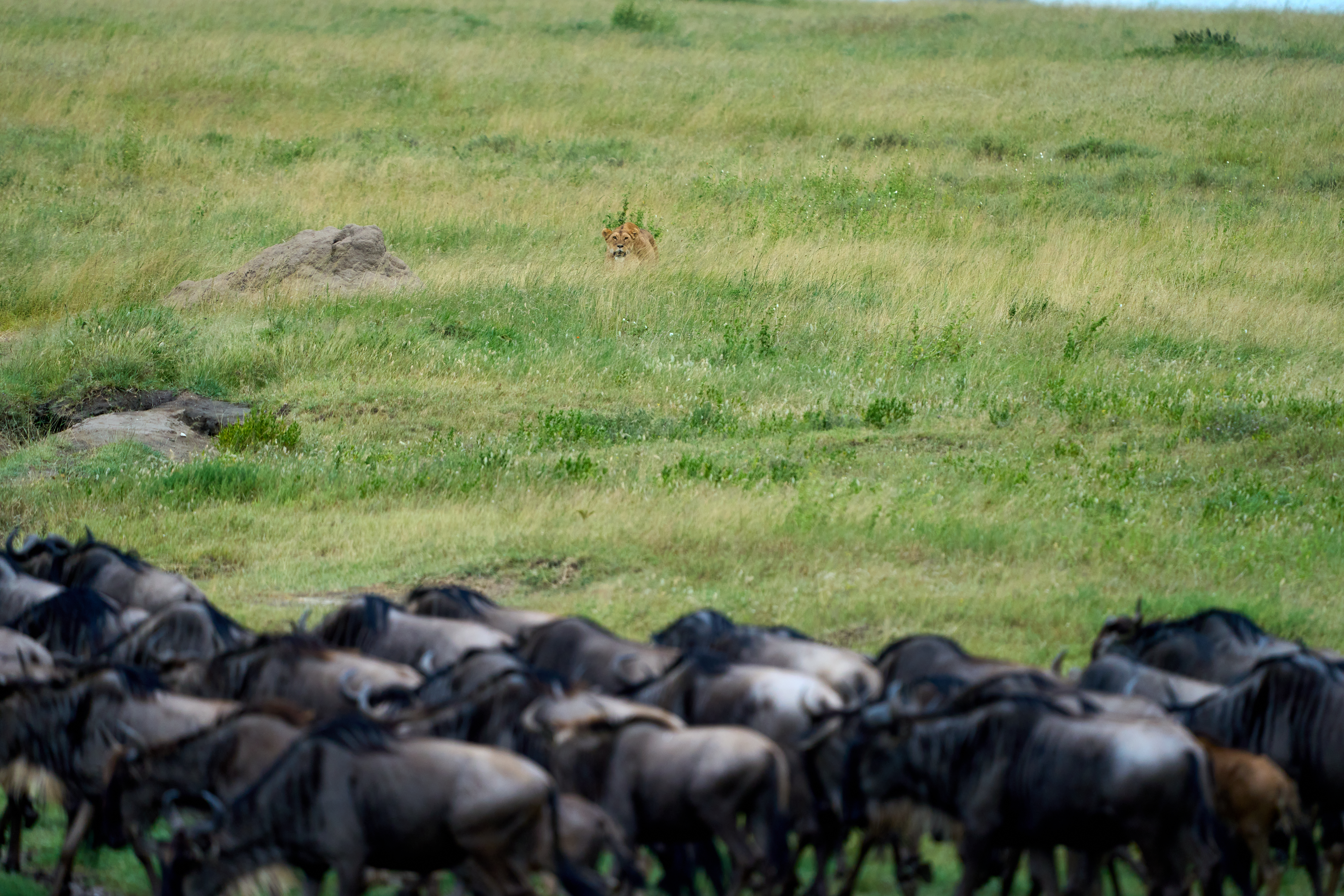
The clearest place to start the annual story is calving, which unfolds on the short-grass plains around Ndutu and the southern Serengeti between roughly late January and March. Here the migration performs one of its most staggering feats of biology: in a window of just two to three weeks, around 400,000 calves are born, tens of thousands a day. By flooding the plains with newborns all at once, the wildebeest overwhelm the predators — there are far more calves than the cats and hyenas can eat, so the great majority survive.
A wildebeest calf is a marvel in its own right. Within minutes of birth it can stand, and within a day it can run fast enough to keep pace with the herd — one of the quickest developments of any hoofed animal. It needs to be. The calving grounds are also a hunting ground, and these weeks bring some of the most concentrated predator action of the year. For the visitor, the Ndutu plains in February offer a rawer, less famous spectacle than the crossings, but arguably a more profound one: life and death at scale on an open stage.
The rut: courtship on the march
As the plains dry out around April and May and the herds begin drifting north and west, the migration enters a phase few visitors ever hear about: the rut. Over a few frenetic weeks, usually late May into June, the bulls establish temporary territories on the move, grunting incessantly and clashing horns as they compete for mating. It is chaos with a purpose. Roughly 90 per cent of breeding-age females are mated within the same brief window, which is precisely why, eight and a half months later, the calving is so tightly synchronised.
The rut is the hidden hinge of the whole cycle. That extraordinary birth synchrony — the survival strategy of overwhelming the predators — is only possible because conception is equally synchronised, and conception is timed by the rain-driven rut. The noise of half a million grunting, sparring wildebeest is a reminder that the migration is not a march of clones but a living society, full of competition, hierarchy and reproduction.
The river crossings
The crossings are the migration's most famous scenes, and they earn their fame. As the dry season tightens from around June onward, the herds press north in search of grazing and water, and their path is barred by rivers — first the Grumeti in the western Serengeti, then the far larger Mara River on the Kenya-Tanzania border from July through October. The crossings are dramatic precisely because they are dangerous: the banks are steep, the current strong, and the water holds some of the largest crocodiles in Africa, ancient reptiles that time their year around this single moving feast.
What the documentaries rarely explain is the psychology of a crossing. Wildebeest are torn between the pull of fresh grass on the far bank and a deep, sensible fear of the water. They mass at the edge for hours or even days, milling and hesitating, until some trigger sends them plunging in. Then thousands pour across in a churning torrent, some drowning, some taken by crocodiles, most surviving. The chaos is real, but so is the logic: crossing is a calculated risk the herd must take to reach the grazing that keeps it alive.
The return and the eternal circle
By the late dry season the herds are spread across the northern Serengeti and Kenya's Masai Mara, grazing the tall grasses the earlier rains left behind. Then, with the short rains around November, the whole vast movement reverses. Sensing the greening of the southern plains, the herds pour back south and east through the central Serengeti to arrive once more on the calving grounds of Ndutu by December and January. The circle closes exactly where it began, and the following year's calves are born on the same mineral-rich soils that produced their mothers.
This is the crucial thing to grasp about the great wildebeest migration: there is no start line and no finish. The herds are always somewhere in the loop, always moving, always following the rain. What we label as separate events — the calving, the rut, the crossings, the return — are simply the chapters we notice as the same animals pass the same landmarks year after year. The migration is less a journey than a standing wave, a pattern that persists while the animals within it are born, breed and die along the way.
The supporting cast: zebra and the predator economy
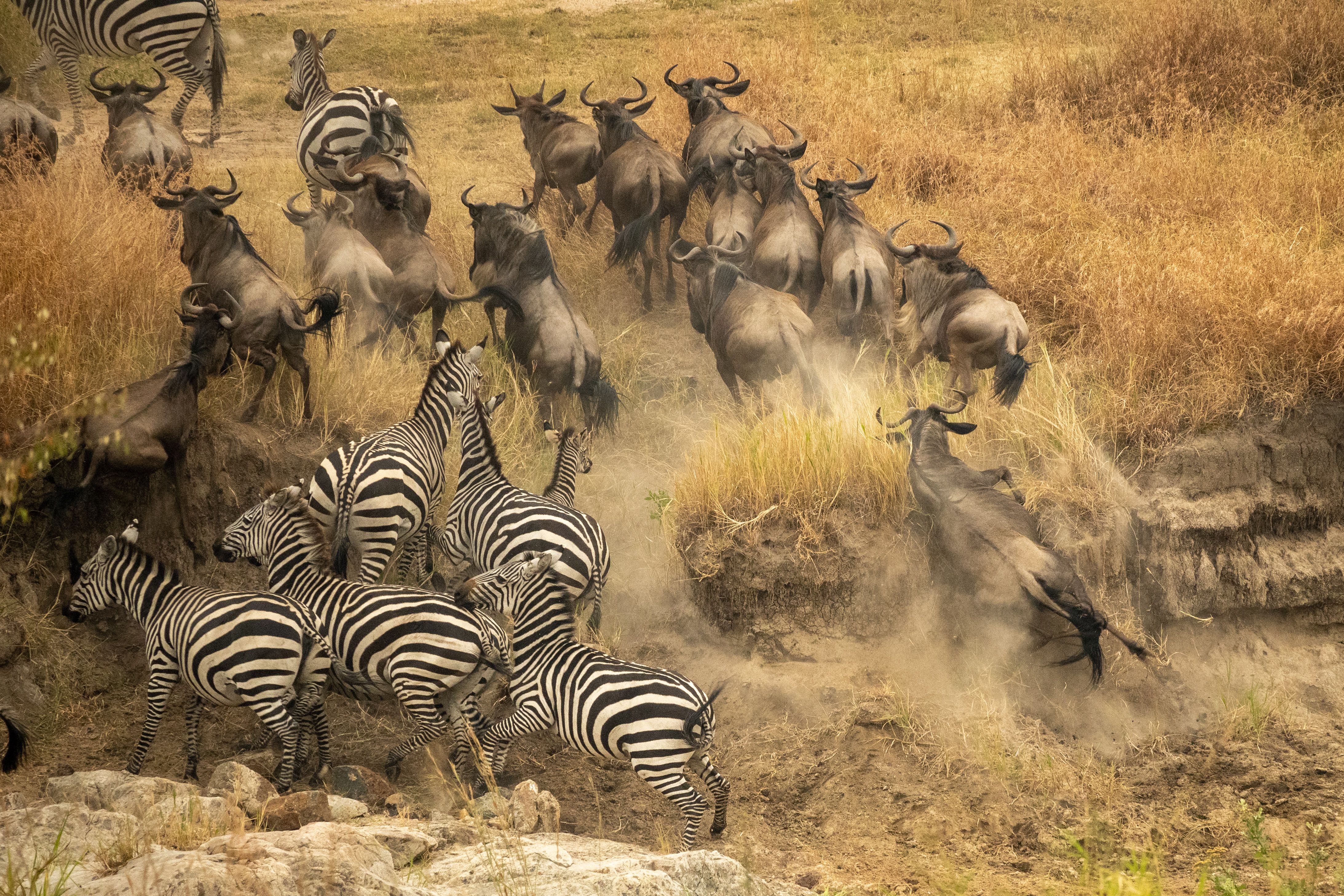
The wildebeest do not travel alone, and their most important companions are zebra. Around 200,000 zebra move with the herds in one of nature's neatest partnerships. Zebra prefer the longer, coarser tops of the grass, which they crop first with their strong teeth, exposing the shorter, softer growth beneath that the wildebeest favour. The two species also pool their defences: zebra have excellent eyesight and long memories for terrain, while wildebeest have a keen sense of smell for water and danger. Together they see and smell more than either could alone.
Then there is the predator economy, the vast web of meat-eaters the migration feeds. The Serengeti supports one of the densest lion populations on Earth precisely because the herds deliver a moving supply of prey; cheetahs, leopards, hyenas, wild dogs, jackals and vultures all take their share, and the Mara crocodiles stake their entire year on the crossings. Nothing is wasted, and the sheer biomass of the migration underwrites the richness of predator life that makes this ecosystem the wonder it is.
The numbers that stagger
The scale is worth pausing on, because the figures are hard to picture. Around 1.5 million wildebeest, roughly 200,000 zebra and several hundred thousand gazelle move through an ecosystem of some 30,000 square kilometres spanning Tanzania and Kenya, walking a loop of perhaps 800 kilometres each year. In the space of three weeks the population produces around 400,000 calves; over the same cycle it loses a comparable number to predators, drowning and disease. It is a system in constant balance, births and deaths roughly matched, the great river of animals holding its shape year after year.
Threats to the migration
For all its apparent permanence, the migration is more fragile than it looks, because it depends on the herds moving freely across the entire ecosystem. The single greatest threat is anything that blocks that movement: fences, roads, farms and settlements that fragment the range and cut the herds off from the grazing or calving grounds they must reach. Proposals for a commercial highway across the northern Serengeti, and the steady spread of agriculture around the ecosystem's edges, are exactly the pressures that could, in time, break the circle the animals have followed for millennia.
Climate change adds a subtler danger. The whole migration is choreographed by rainfall, and if the seasonal rains become more erratic — arriving late, failing, or falling in the wrong place — the herds can be pulled out of step with the grass and the calving grounds, with serious consequences for survival. The reassuring news is that the core of the ecosystem remains protected and the herds remain strong, but the migration is a privilege that depends on active conservation, and should never be taken for granted.
How to witness each stage
Once you understand the migration as a moving cycle, planning to see it becomes a matter of matching your month to the herds' location. For the calving explosion, come to the Ndutu and southern Serengeti plains in late January and February; for the western Grumeti crossings, aim for June; and for the celebrated Mara River crossings, the northern Serengeti and Masai Mara are the place from July through October. There is no single "best" time — only the best time for the chapter you most want to see.
This is where local knowledge earns its keep, because the herds do not read calendars and their exact position shifts with each year's rains. At Sokwe Africa Safaris we track the migration in real time and position our guests in mobile and permanent camps that sit where the action will be, not where it was last season. Tell us your month and what you most want to witness — the newborn calves, the thunder of a river crossing, or the sheer scale of the massed herds — and we will place you exactly where the herds will be.
Frequently asked questions
When is the great migration?
It never stops — the herds circle the Serengeti-Mara ecosystem all year, and only the chapters change. Calving falls on the southern plains from late January to March, the rut in late May and June, the Grumeti crossings around June, the Mara River crossings from July through October, and the return south with November's short rains.
Where is the great migration now?
In August the herds are spread across the northern Serengeti and Kenya's Masai Mara, massing along the Mara River for crossings that run through to October. By November they pour south again, reaching the Ndutu calving grounds by December and January. Exact positions shift with each year's rains, which is why we track the herds week by week.
How many wildebeest are there?
Around 1.5 million wildebeest move through the Serengeti-Mara ecosystem, joined by roughly 200,000 zebra and several hundred thousand gazelle across some 30,000 square kilometres, walking a loop of perhaps 800 kilometres a year. Births and deaths roughly match each cycle, so the great river of animals holds its shape year after year.
When do the wildebeest cross the Mara River?
From July through October, once the tightening dry season pushes the herds north to the Kenya-Tanzania border. The earlier Grumeti crossings in the western Serengeti come around June. There is no timetable: the herds mass at the banks for hours or even days, milling and hesitating, until some trigger sends thousands plunging in at once.
When is the wildebeest calving season?
Late January to March on the short-grass plains around Ndutu and the southern Serengeti, with calves arriving at tens of thousands a day during a window of just two to three weeks. Flooding the plains with newborns at once overwhelms the predators, so the great majority survive. A calf can run with the herd within a day of birth.
Why is the great migration important?
It is the engine of the entire ecosystem. The herds crop and fertilise the grasslands as they move, and their sheer biomass underwrites one of the densest predator populations on earth — lion, cheetah, leopard, hyena, wild dog, and the Mara crocodiles that stake their whole year on the crossings. Fences, roads and farms that block the circuit are the real threat.