
Ngorongoro Crater is one of the most photographed places in Africa, and it provokes a long list of practical and curious questions. How big is it? How did it form? Is it really a crater, and is it still active? Can the animals walk out? Can you sleep on the crater floor? Is it one of the Seven Wonders of the World? We take guests there regularly, and we have gathered the answers in one place, with the figures given as the commonly published ones, since sources vary slightly. Where a number is approximate or disputed, we say so, because a confident wrong answer helps nobody.
The short answers
Ngorongoro Crater is a collapsed volcanic caldera in northern Tanzania, with a floor of roughly 260 square kilometres and walls about 600 metres high. It formed when a large volcano erupted and collapsed in on itself some two to three million years ago. It sits inside the Ngorongoro Conservation Area, which is a UNESCO World Heritage Site and not a national park, and it is home to a very dense population of wildlife. It is not an active volcano, and it is not one of the Seven Wonders of the World, although it was named one of the Seven Natural Wonders of Africa in 2013.
Where is Ngorongoro Crater?
The crater is in northern Tanzania, in the Crater Highlands, about 180 kilometres west of Arusha by road, which is typically a drive of three to four hours depending on conditions. It lies to the east of the Serengeti, with which it shares a border and a wildlife system, and it is the second stop on the classic northern circuit after Tarangire and Lake Manyara. It is not in the Serengeti National Park, though it is often visited on the way to or from it, and it is not in the city of Arusha, which is the nearest large city and the usual starting point.
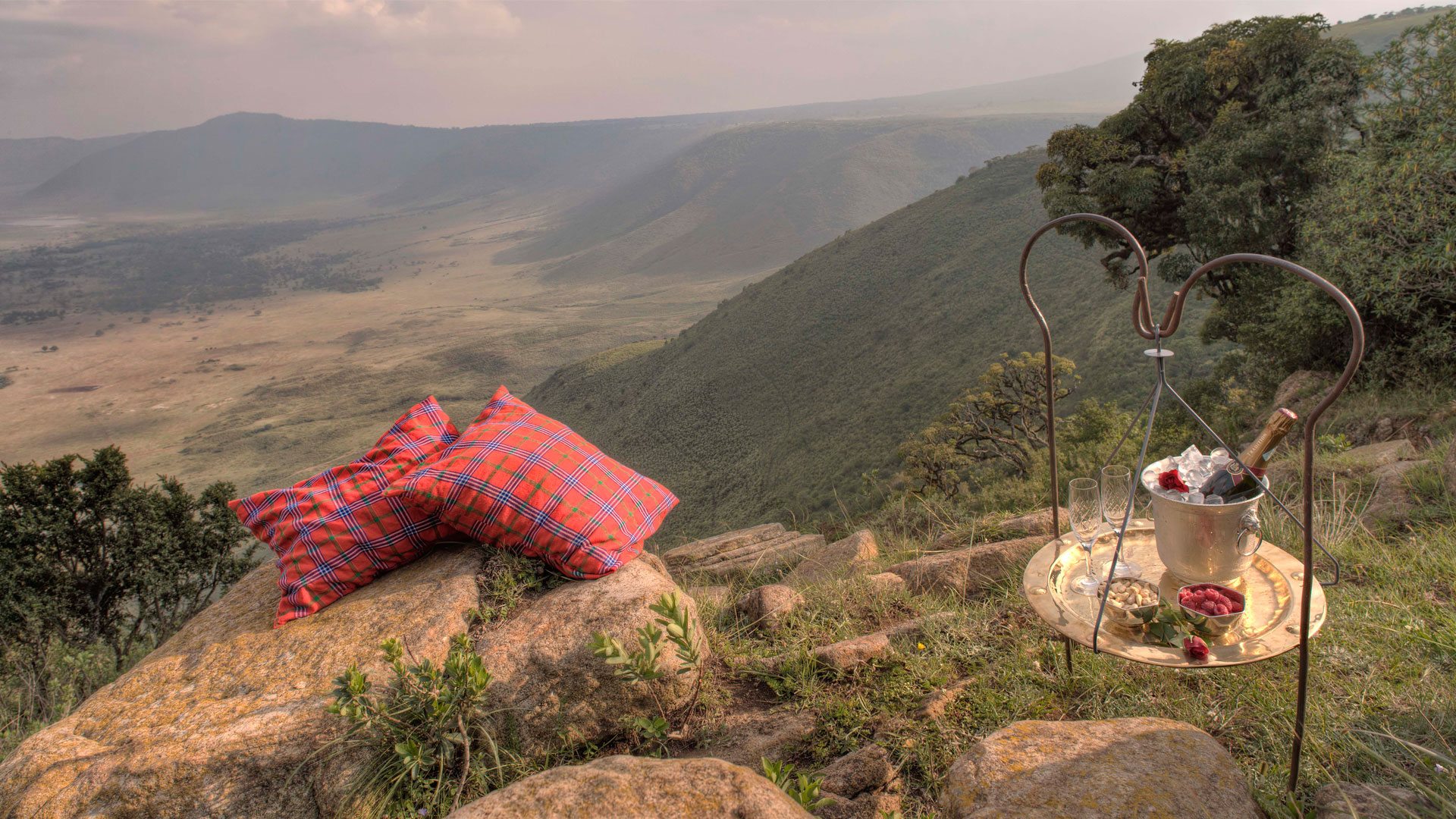
The nearest towns are Karatu, on the road in from Arusha, and Mto wa Mbu below Lake Manyara. The crater rim is reached by a road that climbs the escarpment, and visitors then descend by designated tracks to the floor. Most guests stay either on the rim, in lodges and camps with views across the caldera, or in the farmland around Karatu, which is lower, greener and more affordable. Our guide on whether the crater is worth it explains how to decide between them.
How big and how deep is it?
The commonly quoted figures are a floor of around 260 square kilometres and a depth of roughly 600 metres from rim to floor, with a diameter of about 16 to 19 kilometres depending on how and where it is measured. Different sources give slightly different numbers, because a caldera is not a perfect circle and the rim is uneven, so treat these as approximate. The floor sits at around 1,800 metres above sea level, and the rim is higher, at over 2,000 metres, which is why mornings on the rim can be cold and misty.
By any measure it is one of the largest intact calderas in the world, and often described as the largest unbroken, unflooded one. That description is why it is such a distinctive wildlife setting. The walls form a natural amphitheatre, and the floor contains grassland, a soda lake, a freshwater swamp, rivers and patches of forest, which together support an unusually wide range of habitats within a small area. You can cross the entire floor in a morning, which is part of its appeal.
How did it form, and when?
Ngorongoro was once a large volcano, possibly rivalling Kilimanjaro in height, with estimates of its original height ranging from around 4,500 to over 5,000 metres. Geologists believe it erupted and then collapsed into its own empty magma chamber, leaving the bowl we see today. Published dates vary, but the usual range is that this happened about two to three million years ago, with volcanic activity over an extended period before that. The exact numbers differ between sources and are not worth defending to the decimal point.
Plan your visit with our guides: Ngorongoro Crater safari guide, is Ngorongoro Crater worth it, Serengeti vs Ngorongoro and Olduvai Gorge. See our private Tanzania safari options.
More on this in Can you do a one-day safari in Tanzania? The best day trips from Arusha and what to expect.
A related point of confusion is the word crater itself. Strictly, Ngorongoro is a caldera, a large depression formed by the collapse of a volcano after an eruption, and not a crater formed by an impact or by an eruption that blew out the top. The name crater is used almost universally for it, and there is nothing wrong with that in everyday speech. If a guide or a geologist uses the word caldera, they are not contradicting anyone, just being more precise.
Is it still active?
The crater itself is not an active volcano, and there is no volcanic hazard on a visit. Elsewhere in the Crater Highlands there is volcanic activity: Ol Doinyo Lengai, a short distance to the north near Lake Natron, is an active volcano that has erupted in recent decades and is famous for its unusual carbonatite lava. It is a separate mountain and is not part of the crater visit, though it appears in some longer itineraries. If someone says the area is volcanic, they are right; if they say the crater might erupt, they are mistaken.
Is it a national park, and who manages it?
Ngorongoro is not a national park but a conservation area, which is an important distinction. It is managed by the Ngorongoro Conservation Area Authority, and unlike a national park, it is designed to allow human use alongside wildlife, including grazing by Maasai pastoralists in parts of the area. It was inscribed as a UNESCO World Heritage Site in 1979, and the listing also reflects the importance of Olduvai Gorge, where some of the most significant early human fossils have been found. Fees and rules differ from national parks, which is why entry is arranged and paid through a different system.
This management model has been the subject of public debate in recent years, concerning the people who live in the conservation area, and we mention it because visitors sometimes ask. For the practical purposes of a visit, what matters is that you need permits and fees for the conservation area and a separate fee for each vehicle that descends into the crater, and that your operator should arrange them.
Is it one of the Seven Wonders?
Not of the world. It is sometimes described as one of the Seven Natural Wonders of Africa, a title that was announced in 2013 following a public campaign and vote. The list is a promotional designation and not an official classification, in the way that UNESCO World Heritage status is, but it reflects how highly the crater is regarded. If you read that it is a wonder of the world, that is an exaggeration; if you read that it is a natural wonder of Africa, that is accurate as a title, though not an official one.

What animals live there, and can they leave?
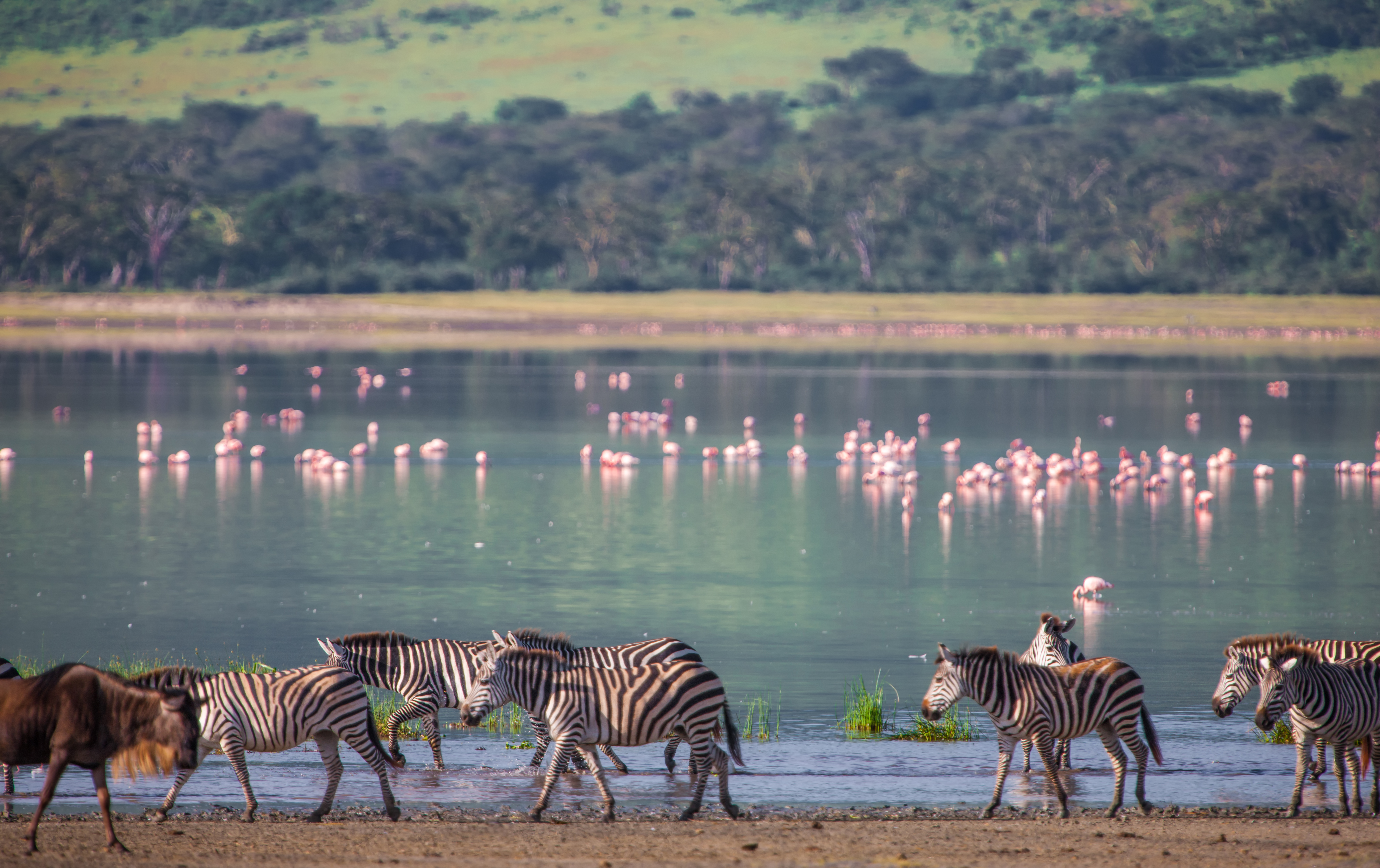
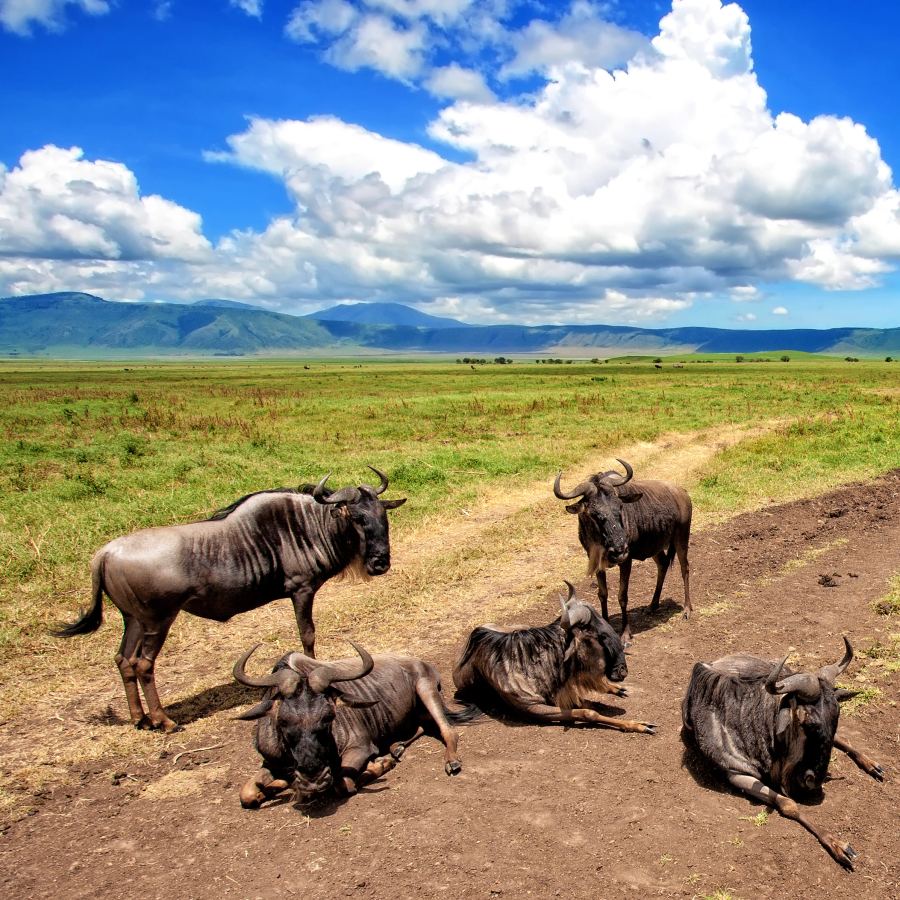
The crater is known for its density of wildlife, and the commonly cited figure is about 25,000 large animals, including wildebeest, zebra, gazelles, buffalo, hippos, elephants, lions, hyenas and a small population of endangered black rhino. Numbers vary from year to year, and several species have fluctuated, with lion numbers in particular affected by disease and other pressures. Giraffes and leopards are rarely or not seen on the floor, and flamingos on Lake Magadi come and go depending on water levels and season.
There are no fences around the crater, and animals can move in and out, though the steep walls and the abundant food and water on the floor mean that many stay for much of the year. Some animals, such as wildebeest and zebra, do move between the crater and the surrounding highlands at certain times, and elephants and others use the paths up the walls. It is therefore not a closed zoo, but a natural system whose walls make it unusually self-contained, which is what makes the wildlife so reliably visible.
Can you stay or camp on the crater floor?
As far as we know, visitors cannot camp or stay overnight on the floor of the crater. Lodges, camps and campsites are on the rim or in the surrounding area, and visits to the floor are day trips, with a time limit set by the authorities. Rules can change and are enforced by the conservation authority, so confirm the current position with your operator. If you want to sleep with the crater below you, a lodge on the rim is the best way, and many guests rate it as one of their most memorable nights.
The usual pattern is to descend early in the morning, spend several hours on the floor, have a picnic lunch at a designated site and climb back out around midday. Gates open early in the morning and close in the evening, and vehicle numbers on the floor are limited at any one time, which is one reason to start early. Sources report that the time allowed on the floor is limited to about six hours, though this may change, so check with your operator on the day.
When is the best time to visit?
The crater can be visited all year, because the animals do not migrate away. The dry season, roughly June to October, has the best roads and is busiest, and the green season, roughly November to May, is quieter and lusher, with lower rates, though April and May are the wettest months. Flamingos are often seen on Lake Magadi in some months, though their presence depends on conditions, so do not plan the whole trip around them. Bring warm clothes for the cold rim and an early descent, in any month.
The crater is also a good place to visit if you have only a short time, since the wildlife is so concentrated. Combined with Tarangire and Lake Manyara, and followed by the Serengeti, it forms the classic northern circuit. If you want help working out how many nights to allow, where to stay and how to avoid the worst of the crowds, we are happy to talk it through.

Want the crater to fit well into your itinerary? Talk to Sokwe Africa Safaris and we will plan the timing, the rim or Karatu stay and the early start.
Frequently asked questions
How big is Ngorongoro Crater?
The floor is roughly 260 square kilometres, with a diameter of about 16 to 19 kilometres depending on how it is measured. Figures vary slightly between sources, so treat them as approximate.
How deep is Ngorongoro Crater?
The walls rise roughly 600 metres from the floor to the rim, and the floor sits at around 1,800 metres above sea level. The rim is over 2,000 metres, so mornings can be cold.
Is Ngorongoro Crater a volcano?
It is a collapsed volcano, a caldera, formed some two to three million years ago. It is not active, though Ol Doinyo Lengai nearby is an active volcano.
Is Ngorongoro Crater one of the Seven Wonders of the World?
No, but it was named one of the Seven Natural Wonders of Africa in 2013, a promotional title and not an official classification. It is a UNESCO World Heritage Site.
Can animals leave Ngorongoro Crater?
There are no fences, so animals can move in and out, though the walls and the plentiful food and water keep many on the floor for much of the year.
Can you camp or stay in Ngorongoro Crater?
As far as we know, not on the crater floor. Lodges and campsites are on the rim or nearby, and visits to the floor are day trips with a time limit. Confirm current rules with your operator.