
Route status update: Lemosho and Londorosi (15 October 2026)
According to press reports, Tanzania National Parks (TANAPA) temporarily closed the Lemosho and Londorosi routes on Kilimanjaro on 28 September 2026 because of a fire in the Sangarini-Kamwanga area, and climbers were redirected to the Machame, Marangu and Rongai routes. We have not seen a reopening date, so the situation may already have changed by the time you read this. If you are planning a climb in the coming weeks, please ask us to confirm the current status of your route before you book or pay for anything, and we will tell you plainly if an itinerary needs to change. The route descriptions below show how each route normally runs.
The roof of Africa
Mount Kilimanjaro is Africa's highest peak and the tallest free-standing mountain on Earth — a snow-capped giant rising 5,895 metres straight out of the East African plains. It is not part of any mountain range; it stands utterly alone, which is why the first sight of it, floating above the clouds with the savannah at its feet, stops people mid-sentence. It is a dormant volcano, a national park, a World Heritage Site and, for tens of thousands of trekkers every year, the summit of a lifetime — reachable on foot without a single rope or ice axe.
As a Tanzanian operator based in Arusha, we live and work in the mountain's shadow. This guide covers the mountain itself: where it is, exactly how tall it is, the story of the three volcanic cones, the climb through five climate zones from rainforest to arctic summit, the shrinking glaciers, and — honestly and briefly — how climbing it works, with links to our deeper guides on routes and costs when you are ready to plan.
Where is Mount Kilimanjaro?
Mount Kilimanjaro is in northern Tanzania, in East Africa, close to the border with Kenya. It rises above the town of Moshi, about 80 kilometres east of Arusha, the safari capital of the north, and roughly 330 kilometres south of the equator, protected within Kilimanjaro National Park. A common misconception, fed by decades of postcards shot from Amboseli, is that the mountain is in Kenya — that classic view with elephants in the foreground is indeed from the Kenyan side, but the mountain itself, every route and the summit are entirely Tanzanian.
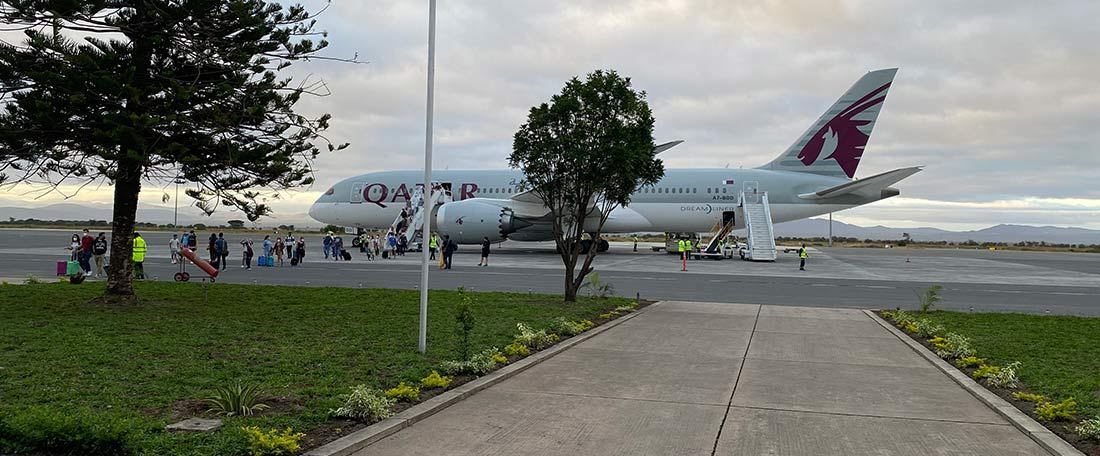
Getting there is simpler than most people expect. Kilimanjaro International Airport (JRO) sits on the plains between Arusha and Moshi, with direct flights from Europe and the Gulf, and it is under an hour's drive from the towns where climbs begin. This is also what makes the mountain pair so naturally with a safari: the Serengeti, Ngorongoro Crater and Tarangire all lie a short hop to the west, so one trip can hold both the summit and the plains.
How tall is Mount Kilimanjaro?
Kilimanjaro stands 5,895 metres above sea level — 19,341 feet — at Uhuru Peak, its highest point. That makes it the highest mountain in Africa, one of the Seven Summits, and the tallest free-standing mountain in the world: unlike Everest, which rises from a high range, Kilimanjaro climbs almost five vertical kilometres directly from plains at around 900 metres. Nowhere else on Earth can you stand on hot savannah and look up at glaciers in a single glance.
The numbers deserve a pause. The summit is high enough that the air holds roughly half the oxygen available at sea level, which is why altitude, not fitness, decides who reaches the top. Yet the terrain is gentle enough that no technical climbing is required at all. That combination of serious altitude and walkable slopes is what makes Kilimanjaro unique among the world's great peaks: the highest place an ordinary, determined person can walk to.
Kilimanjaro the volcano: Kibo, Mawenzi and Shira
Kilimanjaro is a stratovolcano, built over hundreds of thousands of years by successive eruptions, and it is really three volcanoes in one. The mountain has three cones: Shira in the west, the oldest, which collapsed long ago and survives as a broad plateau at around 3,800 to 4,000 metres; Mawenzi in the east, a jagged spire of 5,149 metres that is off limits to trekkers; and Kibo in the centre, the youngest and highest, the great snow-capped dome that everyone pictures when they hear the name Kilimanjaro.
Kibo is classified as dormant, not extinct — an important distinction. Its last major eruption was around 360,000 years ago, and the most recent volcanic activity is thought to have been a mere 150 to 200 years ago. Stand on the crater rim today and the volcano quietly reminds you it is sleeping rather than dead: fumaroles in the inner Reusch Crater still vent sulphurous gases. Scientists monitor it and there is no sign of an awakening — but you do summit a living piece of geology.
Uhuru Peak, the point every climber aims for, is simply the highest spot on Kibo's crater rim. The name means "freedom" in Swahili, given after Tanzanian independence in 1961. Walking the final stretch of rim from Stella Point to Uhuru at dawn, with the crater's ice walls on one side and the plains far below on the other, is the moment the whole mountain has been building towards — and it belongs to trekkers, not mountaineers.
Five climate zones from rainforest to arctic summit
One of the most remarkable facts about Kilimanjaro is that climbing it compresses the climates of an entire planet into a single week. Because the mountain rises so far and so steeply from the tropics, it stacks five distinct ecological zones on top of one another, and trekkers walk through every one of them. The journey from gate to summit is, quite literally, the climatic equivalent of walking from the equator to the poles in a few days.
The climb begins in the cultivated foothills, a fertile band of coffee and banana farms fed by the mountain's own streams, then enters montane rainforest from roughly 1,800 to 2,800 metres — a dripping, mossy world of colobus monkeys, turacos and giant tree ferns. Above the treeline comes the heath and moorland zone, open country of giant heathers and the otherworldly giant groundsels and lobelias that grow nowhere else. Higher still, from about 4,000 metres, lies the alpine desert: a stark, beautiful landscape of rock and dust where temperatures swing wildly between fierce sun and freezing night.
Finally, above roughly 5,000 metres, comes the arctic zone — a world of scree, ice fields and glaciers where almost nothing lives and night temperatures can fall to minus twenty. Summit day starts here, usually around midnight, climbing frozen ground under the stars to reach the rim for sunrise. The pay-off for the cold is scarcely believable: standing amid equatorial glaciers, watching dawn flood the African plains nearly five kilometres below.
- Cultivated foothills — farms, coffee and villages up to about 1,800 m
- Rainforest — lush, misty, rich in wildlife to about 2,800 m
- Heath and moorland — giant groundsels and huge skies to about 4,000 m
- Alpine desert — stark rock and dust to about 5,000 m
- Arctic summit — glaciers, ice and the roof of Africa at 5,895 m
The snow cap and the shrinking glaciers
Kilimanjaro's snow cap is the mountain's signature — the improbable white crown three degrees south of the equator, which early European geographers were once ridiculed for reporting. The summit ice is ancient, with cores from the Northern Ice Field suggesting glaciers have crowned Kibo for over 10,000 years, and the dazzle of ice above dusty plains remains, for most visitors, the defining image of East Africa.
That crown is disappearing. Kilimanjaro's glaciers have lost around 85 to 90 per cent of their area over the last century, and researchers project that the remaining ice fields could be largely gone within the next couple of decades — a visible casualty of a changing climate and shifting weather patterns around the mountain. Seasonal snowfall will still whiten the summit after storms, but the permanent glaciers that inspired the legends are in retreat. It is a sobering thought, and, candidly, one reason many climbers give for going sooner rather than later.
Who can climb Kilimanjaro?
Here is the fact that surprises people most: Kilimanjaro requires no technical climbing whatsoever. There are no ropes, no crampons on the standard routes, no climbing skills to learn — every metre from gate to summit is walked. Ordinary hill-walkers in their sixties and seventies summit regularly, and children as young as ten, the park's minimum age, have stood on Uhuru Peak. If you can walk uphill for five to seven hours a day, several days running, the mountain is within reach.
What decides success is altitude, and the honest answer is that acclimatisation matters far more than athleticism. Roughly two thirds of climbers overall reach the summit, but on longer seven- and eight-day itineraries success rates climb above 85 to 90 per cent, simply because the body is given time to adapt. Tanzanian law requires every climber to be accompanied by a licensed guide, and a full crew of porters and a cook carries the camp — so your job is genuinely just to walk slowly, eat well, drink constantly and let the days do the work.
How a climb actually works
A Kilimanjaro climb is a supported trek of five to nine days inside the national park. You sleep in tents at designated camps, or huts on the Marangu route, your crew moves camp ahead of you each day, and daily stages are deliberately short — the guides' refrain of pole pole, slowly slowly, is the best advice on the mountain. Summit night is the exception: a midnight start, six to eight hours of cold, slow climbing to the rim for sunrise, then a long descent. It is hard, and it is meant to be — that is why it counts.
The two big planning decisions are route and operator. There are seven main routes — Machame, Lemosho, Marangu, Rongai, the Northern Circuit and others — differing in scenery, traffic, difficulty and acclimatisation profile, and choosing well genuinely changes your odds of summiting. Budget matters too: park fees alone run to hundreds of dollars, and a properly staffed, properly paid crew has a real cost, which is why suspiciously cheap climbs are suspicious. We have written detailed guides on both, linked below, and our Kilimanjaro trekking page covers the itineraries we run.
If you are planning this route, read Best time to climb Kilimanjaro: month-by-month verdicts.
More on this in Mount Meru: Tanzania's brilliant second mountain.
Kilimanjaro is the highest place on Earth an ordinary, determined person can simply walk to — five climate zones, one summit, no ropes.
When to see and climb the mountain
Kilimanjaro can be climbed year-round, but two dry windows are clearly best: January to early March, which is slightly warmer and quieter, and June to October, which coincides with peak safari season and brings the most reliably clear skies. The long rains of April and May are the months to avoid — trails are wet, views vanish into cloud and camps are damp. Hoping to see the summit from the plains? Early mornings in the dry seasons are the golden hours, before the daily cloud builds around Kibo.
Even if you never intend to climb, the mountain rewards a visit. The lower slopes offer superb day hikes through the rainforest to waterfalls, the coffee farms around Moshi welcome visitors, and on clear mornings the view of the ice-capped summit from the plains is one of Africa's great sights. Many of our safari guests build in a day around the mountain's feet precisely for that view — the giant is worth meeting even from below.
Kilimanjaro and safari: two trips in one
The mountain's location is a gift to trip planners. Because Kilimanjaro stands beside Tanzania's northern safari circuit, a climb combines seamlessly with the Serengeti, Ngorongoro Crater and Tarangire — a week on the mountain followed by four or five days among the wildlife, all from the same airport, is one of the world's great adventure itineraries. Most climbers trek first and let the safari be the reward: after summit night, being driven across the crater floor while someone else does the work feels close to heaven.
A few days on Zanzibar's beaches makes the classic finale, turning one trip into three — summit, safari and Indian Ocean. Linking these pieces, with the right rest days in Arusha between them, is exactly the planning a local operator does daily. Sokwe Africa Safaris runs both the mountain and the parks, so the whole journey — airport pickup, climb, safari, beach — is handled by one team that answers to you.
Stand on the roof of Africa
Mount Kilimanjaro is that rare wonder that is both world-famous and genuinely attainable — a dormant volcano wearing glaciers on the equator, which ordinary people walk up every week of the year. Whether you dream of sunrise on Uhuru Peak or simply want to see the snow cap floating above the savannah on your safari, the mountain deserves a place on your Tanzanian journey. When you are ready to stand on the roof of Africa, we organise the whole journey from Arusha — routes, crew, safari and beach — so all you have to do is walk.
Plan your Kilimanjaro climb with Sokwe Africa Safaris
Frequently asked questions
Where is Mount Kilimanjaro?
Mount Kilimanjaro stands in northern Tanzania, in East Africa, close to the Kenyan border and roughly 330 kilometres south of the equator. It rises above the town of Moshi, about 80 kilometres east of Arusha, protected within Kilimanjaro National Park. Kilimanjaro International Airport sits on the plains between the two towns, under an hour from where most climbs begin.
How tall is Mount Kilimanjaro?
Kilimanjaro is 5,895 metres above sea level, or 19,341 feet, measured at Uhuru Peak on the Kibo cone. That makes it the highest mountain in Africa, one of the Seven Summits, and the tallest free-standing mountain on Earth, rising almost five vertical kilometres from plains lying at around 900 metres.
What country is Kilimanjaro in?
Kilimanjaro is entirely in Tanzania. The famous postcard view with elephants in the foreground is photographed from Amboseli in Kenya, which fuels the common belief that the mountain is Kenyan, but the border runs below it: every route, every camp and the summit itself lie inside Tanzania's Kilimanjaro National Park.
Is Mount Kilimanjaro a volcano?
Yes. Kilimanjaro is a stratovolcano, and really three volcanoes in one: Shira in the west, now a collapsed plateau at 3,800 to 4,000 metres, jagged Mawenzi at 5,149 metres, and Kibo in the centre, which carries the summit. Kibo is classified as dormant rather than extinct, and fumaroles in the inner Reusch Crater still vent sulphurous gases.
What is Mount Kilimanjaro?
Kilimanjaro is Africa's highest peak, a dormant volcano, a national park and a World Heritage Site in northern Tanzania. It is the tallest free-standing mountain in the world, rising alone from the savannah through five climate zones, from farmland and rainforest to alpine desert and an arctic summit, and it is walked rather than climbed: no ropes or ice axes are needed.
How big is Mount Kilimanjaro?
The mountain is a giant by any measure: three volcanic cones spread across a massif that begins on plains at around 900 metres and finishes at 5,895 metres, so climbers gain almost five vertical kilometres. Within that span sit five climate zones, from coffee and banana farms to equatorial glaciers, all protected inside Kilimanjaro National Park.