
Why so many people start in Nairobi
Nairobi is the best-connected airport in East Africa, with far more international flights and often cheaper fares than Kilimanjaro, and a great many travellers bound for the Serengeti land there first. The distance is the catch. Nairobi to the central Serengeti is roughly 450 kilometres as the crow flies, a border, and two countries' worth of park regulations. There are three real ways to make the journey, and the right one depends on how many days you have and how much you value the road.
There is a second reason beyond the fares. Nairobi is where a Kenyan safari starts, and a great many travellers who end up in the Serengeti got there because they added Tanzania to a Kenyan trip rather than the other way round. If that is you, the routes below are the second half of a two-country journey rather than the whole of it, and the Namanga road makes more sense than it does for someone flying in purely for the Serengeti.
Route one: fly
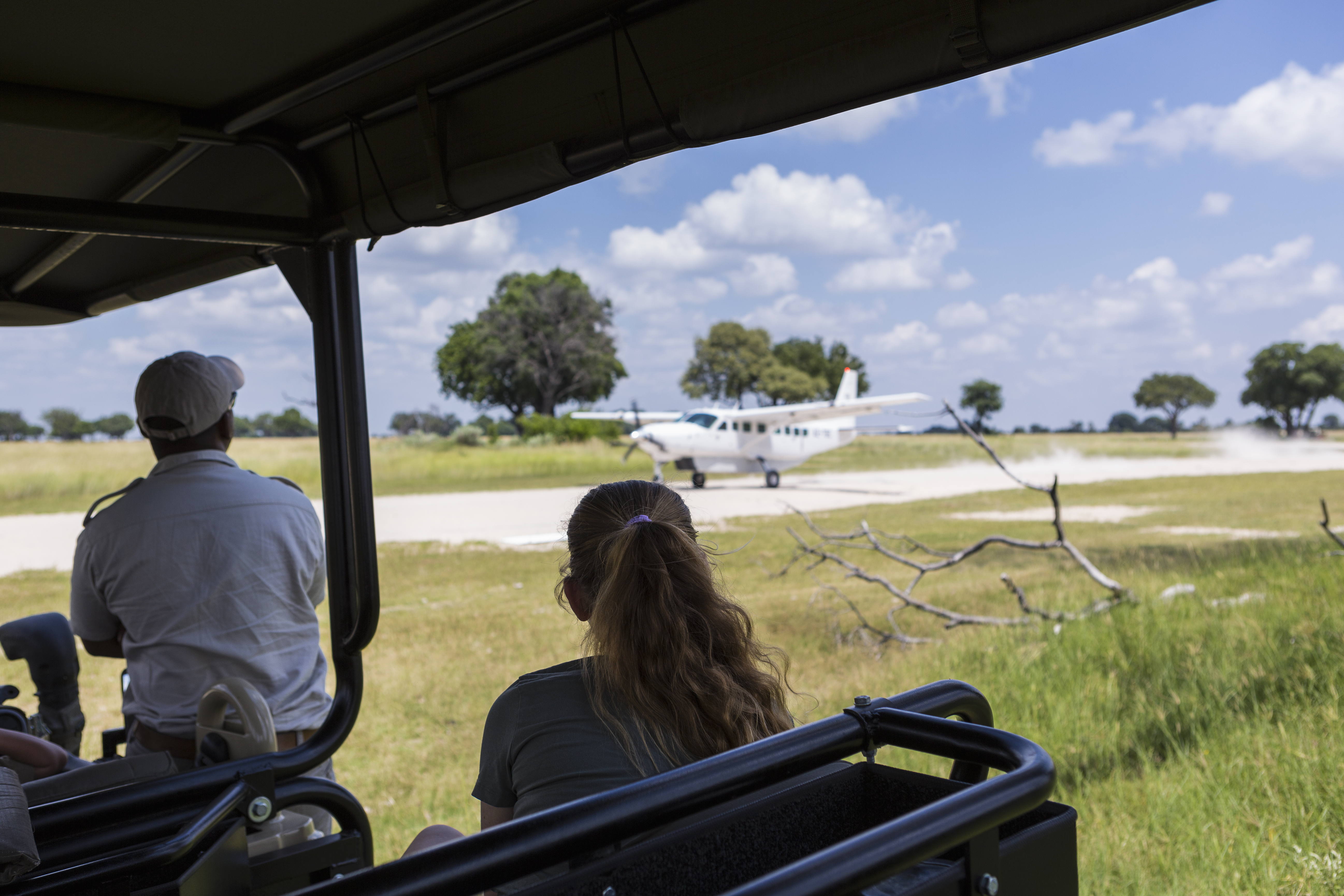
The quickest and most comfortable route is to fly. Nairobi's Jomo Kenyatta and Wilson airports both connect to Kilimanjaro International, a flight of under an hour, and from Kilimanjaro or Arusha the domestic charter network reaches the Serengeti's airstrips — Seronera in the centre, Kogatende in the north, and others — in about an hour more. With sensible connections you can leave Nairobi after breakfast and be on a game drive in the Serengeti by mid-afternoon.
The cost is the trade-off. Expect the Nairobi–Kilimanjaro sector plus a Serengeti sector to run somewhere in the region of 300 to 450 US dollars per person per flight, so two sectors each way adds up. There is also the luggage rule: light aircraft in Tanzania enforce a limit of around 15 kilograms in soft bags, and hard suitcases are refused. Leave a bag at your Nairobi hotel or with us in Arusha, and travel into the bush with what you need.
For anyone with ten days or fewer, this is the route we recommend without hesitation. The road option below consumes most of two days that a short safari cannot spare, and the money saved by driving is rarely worth the days lost.
The flight connections deserve a note, because they are the part that goes wrong. The Nairobi-to-Kilimanjaro flights are scheduled, several times a day, and reliable. The onward flights into the Serengeti are a scheduled charter network — light aircraft on fixed circuits that call at the airstrips in sequence — and their timings are set to connect with the morning arrivals at Kilimanjaro and Arusha. Land at Kilimanjaro by late morning and you will make the afternoon circuit into Seronera; land in the evening and you will overnight in Arusha and fly the next morning. We build the day around the actual timetable, not the ideal one, and we tell you which of the two you are getting.
Route two: road via Namanga and Arusha
The classic overland route runs south from Nairobi to the Namanga border, across into Tanzania, and on to Arusha — roughly three to four hours to the border and about two more to Arusha. It has become considerably easier since Namanga became a one-stop border post, with Kenyan exit and Tanzanian entry at adjacent counters, and on a normal day the crossing takes twenty to forty-five minutes. Our full guide to the Namanga crossing covers the documents; the short version is passport, Tanzanian visa or the dollars to buy one, and a yellow fever certificate, which is checked.
The important rule is that a Kenyan vehicle cannot continue into Tanzanian parks, so this route is always a hand-over at the border: a Kenyan transfer brings you to Namanga, and our vehicle and guide collect you on the Tanzanian side. From Arusha, the central Serengeti is a further full day by road through Lake Manyara, over the Ngorongoro highlands and down onto the plains, or an hour by air. Most travellers on this route spend the border night in Arusha and either drive the northern circuit in stages — Tarangire, Ngorongoro, then the Serengeti — or fly the last leg.
The reward for the road is the road. The Rift Valley escarpment, Maasai country either side of the border, Mount Meru rising over Arusha, and the descent into the Serengeti from the crater highlands is one of the great drives in Africa. If you have a fortnight and you like the texture of a journey, this is worth doing at least in one direction.
The border itself is covered step by step in our Namanga crossing guide, and the two countries together in Kenya and Tanzania luxury safari.
Related reading: Which airport should you fly into for a Serengeti safari? Kilimanjaro, Arusha, Dar es Salaam and the airstrips.
The Arusha night is not a waste. It is where luggage gets sorted for the light-aircraft limit, where the guide briefs you on the days ahead, and where the trip changes gear from transit to safari. Travellers who push straight through from Nairobi to a camp in Tarangire on the same day arrive after dark, tired, having seen nothing, and start the Tanzanian half a step behind. One night in Arusha and a two-hour drive to Tarangire the next morning costs a few hours and buys a proper beginning.
Route three: the western loop — and why we don't recommend it
Looking at a map, the Masai Mara and the Serengeti are the same ecosystem with a border through the middle, and it seems obvious that you should be able to drive from one to the other. You cannot, as a tourist. The direct Sand River crossing between the Mara and the Serengeti is closed to tourist traffic. The nearest open crossing is at Isebania, west of the Mara, and from there the route into the Serengeti loops through Tarime and Mugumu to the park's western Ikoma gate on long, rough roads.
It can be done, and a handful of operators do it, but it is slow, uncomfortable and expensive relative to what it saves, and the vehicle-and-guide hand-over still applies. Unless you have a specific reason to be on the Serengeti's western side, the honest advice is to fly from the Mara's airstrips to Kilimanjaro and continue from there, or to run the Mara and the northern Serengeti as two separate legs connected through Nairobi and Arusha.
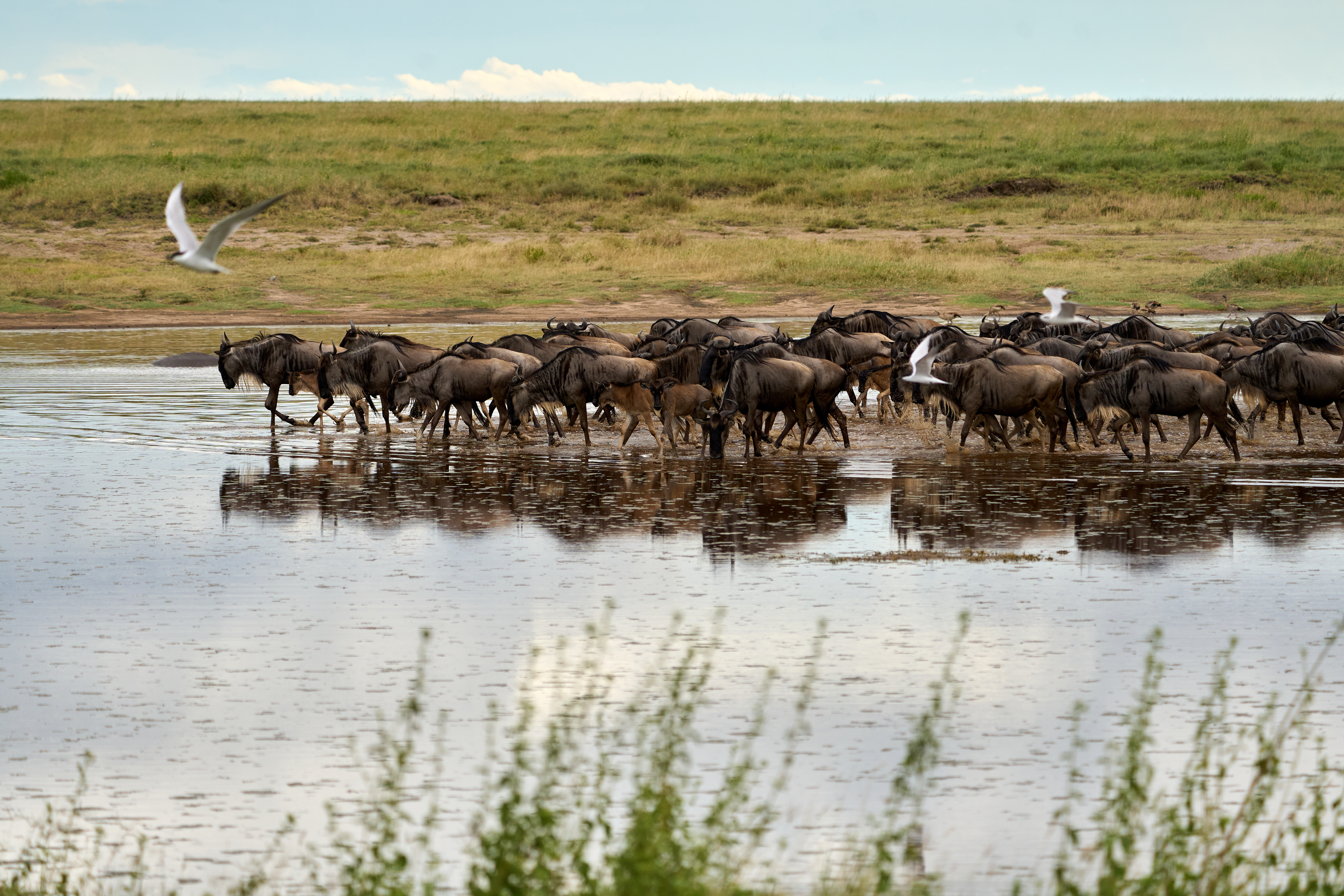
The reason the Sand River crossing is closed is worth knowing, because travellers occasionally push back on it. It is a conservation decision as much as a bureaucratic one: opening a tourist road through the heart of the migration's crossing zone, between two countries with different park rules, was judged to do more harm than the convenience justified. There have been proposals to change it for years. None has succeeded, and we do not plan itineraries around a road that may one day open.
Putting the days together
A realistic Nairobi-to-Serengeti trip of a week looks like this: land in Nairobi, fly to Kilimanjaro the same or next day, transfer to Arusha or straight into Tarangire, then Ngorongoro, then fly or drive into the Serengeti for three nights, and fly out from the Serengeti to Kilimanjaro or Arusha for the flight home. That gives you three Tanzanian parks and the Serengeti properly, without spending two of your seven days on the Nairobi road.
With ten to fourteen days the road option opens up, and so does a Kenyan leg first: the Masai Mara, Lake Nakuru or Amboseli before the crossing, then Arusha and the northern circuit after it. That is the shape of our seventeen-day Wildlife and Primates itinerary, which starts in the Mara and crosses at Namanga on day six. It is also the point at which the trip stops being a journey to the Serengeti and becomes a safari across two countries, which is a better use of the time.
For the return journey the same logic runs in reverse. From the Serengeti you fly to Kilimanjaro or Arusha, and from there either fly to Nairobi for an international connection or drive back through Namanga. Most travellers who came in by road go out by air, because by the end of a safari the appetite for a six-hour drive has gone. Kilimanjaro International has its own long-haul connections too — to Amsterdam, Doha, Istanbul and elsewhere — and for many routes home it is simpler to fly out of Tanzania than to return to Nairobi at all.
Costs, side by side
Flying adds around 300 to 450 US dollars per person per sector, and a Nairobi-to-Serengeti journey by air is typically two sectors. Driving costs the Kenyan transfer to Namanga, the Tanzanian visa of around 50 US dollars for most nationalities, and the days. Once you are in the Tanzanian parks the costs are the same whichever way you arrived: park fees of roughly 70 US dollars per adult per day in the Serengeti, a similar daily fee for Ngorongoro plus about 300 dollars per vehicle for the crater descent, and about 53 dollars per adult per day in Tarangire, on top of accommodation and your private vehicle and guide at roughly 350 to 550 US dollars per person per day for a good standard.
The mistake we see most often is choosing the road to save a few hundred dollars on a short trip, and then spending the first two days of a seven-day safari in a vehicle on tarmac. For a week, fly. For a fortnight, drive one way if you want to. For anything in between, tell us your dates and we will lay out both with the numbers.
The essentials
- Under ten days: fly Nairobi to Kilimanjaro, then into the Serengeti
- Ten days or more: the Namanga road is worth doing in one direction
- Do not plan to drive from the Masai Mara into the Serengeti — the direct crossing is closed to tourists
- Yellow fever certificate required entering Tanzania from Kenya
- Tanzanian visa is separate from the East Africa Tourist Visa
- Light aircraft: around 15 kg in soft bags only
- Every route is a vehicle hand-over at the border — ask who collects you
If you remember one thing from this page, make it the first line of that list. The road is a fine way to see the country when you have the days, and a poor way to spend them when you do not. Everything else — the border, the visa, the vehicle hand-over — is detail we handle for you once the route is chosen.
Tell us your dates
Send us your arrival date in Nairobi, your departure date and airport, and how you feel about long drives, and we will send you both routes costed side by side within a day. We run the Tanzanian side ourselves from Arusha, and we arrange the Kenyan transfer through a partner we will name.
Plan your Nairobi to Serengeti safari
Frequently asked questions
What is the fastest way from Nairobi to the Serengeti?
Fly. Nairobi to Kilimanjaro International is under an hour, and a light aircraft from Kilimanjaro or Arusha reaches the Serengeti's airstrips in about an hour more. Leave Nairobi after breakfast and you can be on a game drive by mid-afternoon.
Can I drive from Nairobi to the Serengeti?
Yes, via the Namanga border and Arusha — three to four hours to the border, two more to Arusha, then a full day to the central Serengeti or a short flight. Your Kenyan vehicle cannot enter Tanzanian parks, so it is a hand-over at Namanga.
Can I drive from the Masai Mara straight into the Serengeti?
No. The direct Sand River crossing is closed to tourist traffic. The nearest open crossing at Isebania leads to a long, rough loop to the Serengeti's western gate. Fly from the Mara instead, or connect through Nairobi and Arusha.
How much does flying Nairobi to the Serengeti cost?
Roughly 300 to 450 US dollars per person per flight sector, and the journey is usually two sectors each way. Light aircraft limit luggage to around 15 kilograms in soft bags.
Do I need a separate visa for Tanzania if I have a Kenyan one?
Yes. The East Africa Tourist Visa covers Kenya, Uganda and Rwanda but not Tanzania. Tanzania's visa is available online in advance or on arrival for around 50 US dollars for most nationalities.
How many days do I need for Nairobi to the Serengeti and back?
Seven days works well if you fly and take in Tarangire and Ngorongoro on the way. Ten to fourteen days allows the road route, a Kenyan park or two first, and the Serengeti without rushing.