
Where Kilimanjaro International Airport actually is
Kilimanjaro International Airport — code JRO, known locally as KIA — is the gateway to northern Tanzania, and almost every safari and Kilimanjaro trek begins here. It sits in open farmland roughly midway between the region's two hub towns: Arusha, about 45 kilometres to the west, and Moshi, about 40 kilometres to the east. There is no city at the airport itself, which surprises some first-time visitors; you land amid maize fields with Mount Kilimanjaro and Mount Meru on either horizon, and everyone drives on to Arusha for safari or Moshi for the mountain.
That location is worth understanding before you book anything, because it shapes your first day. If your trip is a northern circuit safari — Tarangire, Ngorongoro, the Serengeti — you want to head west to Arusha. If you are climbing Kilimanjaro, you head east to Moshi or one of the villages nearer the trailheads. Either way you are looking at a transfer of forty-five minutes to an hour on a good tarmac road, which is precisely why we plan the arrival evening as part of the itinerary rather than leaving it to chance.
Which airlines fly to Kilimanjaro
For an airport serving the world's most famous safari circuit, JRO is refreshingly simple. The flagship connection is KLM's direct flight from Amsterdam, the only non-stop link with Europe, which lands in the evening and makes one-stop connections from most European and North American cities straightforward. Qatar Airways connects through Doha, Ethiopian Airlines through Addis Ababa, and Turkish Airlines through Istanbul — between them covering the Middle East, Asia, and most of the rest of the world with a single change of plane.
Regionally, Kenya Airways links JRO with Nairobi several times daily, which opens up dozens of onward connections, while Precision Air and Air Tanzania connect with Dar es Salaam and Zanzibar. Seasonal and charter services come and go, but those core carriers run year-round and are the ones we recommend building an itinerary around. For a fuller comparison of routes, fares and booking timing, see our guide to flights to Tanzania — the short version is that KLM direct or Qatar via Doha suit most safari travellers best.
- KLM — direct from Amsterdam, evening arrival
- Qatar Airways — via Doha, early-morning arrival
- Ethiopian Airlines — via Addis Ababa
- Turkish Airlines — via Istanbul
- Kenya Airways — via Nairobi, several daily
- Precision Air and Air Tanzania — Dar es Salaam and Zanzibar
Visa on arrival: the honest version
Yes, most nationalities can get a Tanzanian visa on arrival at Kilimanjaro International Airport, and yes, it works — but let us be honest about what it involves. When a full KLM or Qatar flight lands, two to three hundred people file into a modest arrivals hall, and everyone without a visa joins the same queue. After a nine-hour flight, forty-five to ninety minutes of standing in line is a wearying way to start a holiday. The fee is 50 US dollars for most passports and 100 dollars for American citizens, payable in cash with clean, recent US notes.
Our standing advice is simpler: apply for the e-visa online through the official Tanzanian immigration website two to four weeks before you travel. It costs the same, you arrive with the approval on your phone or printed, and you walk through a much faster line. The visa on arrival remains a perfectly legal fallback if your e-visa does not come through in time — approvals occasionally run slow — so carry the cash regardless. Our Tanzania visa guide walks through the application step by step, including the common mistakes that cause delays.
Immigration, bags and the arrivals hall
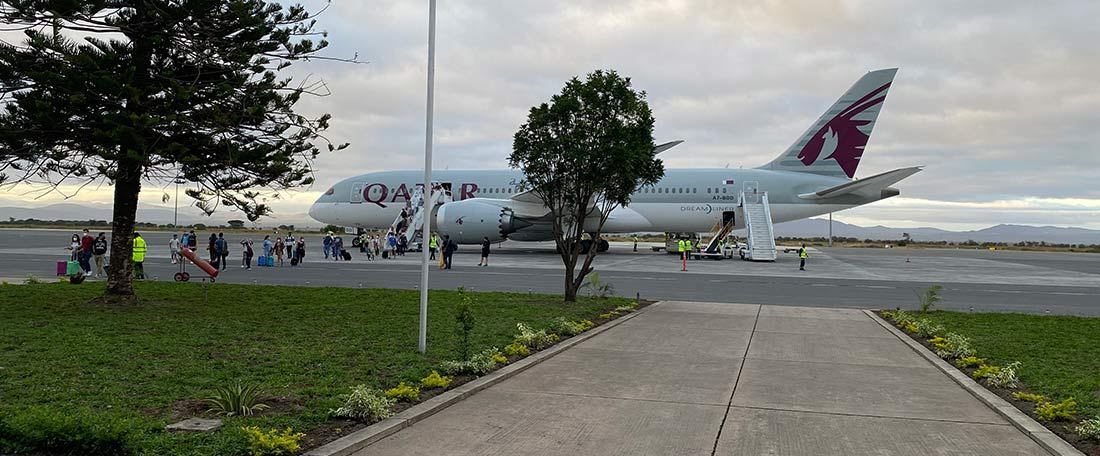
JRO is a small airport, and once you accept that, the arrival is rather charming. There are no endless corridors or trains between terminals; you descend the aircraft steps onto the tarmac, often with Kilimanjaro's snows visible in the morning light, and walk a few hundred metres into the terminal. Immigration is friendly but unhurried — this is Tanzania, and the pace announces itself immediately. With an e-visa and a full flight ahead of you, expect twenty to forty minutes from aircraft to baggage hall; with a visa-on-arrival queue, budget more.
Baggage delivery is generally reliable but not fast, and the hall is compact, so keep your patience and your baggage receipts handy. Delayed bags do happen on tight one-stop connections, particularly through Addis Ababa, and the airlines' local offices handle them competently — bags usually follow on the next day's flight and can be delivered to your Arusha or Moshi hotel. It is one more reason we tell guests to pack a change of clothes, essential medication and their binoculars in hand luggage, and to build a first night near the airport rather than racing straight to a park.
Transfers to Arusha and Moshi
Once through the doors, you have three options: a pre-arranged transfer, an airport taxi or a rental car. The road west to Arusha covers about 45 kilometres and takes fifty minutes to an hour depending on traffic entering town; a licensed airport taxi runs around 50 to 70 US dollars. Moshi is slightly closer to the east — roughly 40 kilometres and forty-five minutes — with taxis at about 40 to 50 dollars. Both roads are good tarmac, and the drive itself is a pleasant introduction, past coffee farms and Maasai herds with Meru or Kilimanjaro filling the windscreen.
We will say plainly what most operators dance around: after a long-haul flight, in a country you have just landed in, negotiating a taxi at night is nobody's idea of fun. This is why every Sokwe safari includes the airport transfer as standard — a driver-guide inside the arrivals hall with a name board, a clean vehicle, cold water, and a first briefing on the drive to your lodge. It costs you nothing extra and removes the single most stressful moment of the trip. If you are travelling independently, arrange a transfer with your hotel in advance rather than deciding on arrival.
SIM cards, money and Wi-Fi at the airport
The practicalities at KIA airport in Tanzania are basic but sufficient. There are mobile-network counters in or just outside arrivals where you can buy a local SIM — Vodacom and Airtel have the best coverage on the safari circuit — for a few dollars, plus a data bundle; registration requires your passport, so have it ready. If your phone supports eSIMs, buying a Tanzania data package before you fly is even easier and lets you message home the moment you land. Airport Wi-Fi exists but is patchy, so do not depend on it for anything important.
For money, the arrivals hall has a bureau de change and ATMs, but treat both as backups rather than the plan. The exchange counters offer mediocre rates, and the ATMs are occasionally empty or offline. The happier truth is that you barely need Tanzanian shillings on a safari: US dollars are accepted for visas, tips and most lodge extras, and your driver can stop at a reliable ATM in Arusha or Moshi for shilling pocket money. Bring US notes printed within the last few years, as older series are widely refused.
Arriving at night: the first-hotel logic
Many of the best flights into Kilimanjaro International Airport land in the dark — KLM arrives around eight-thirty in the evening, and Qatar's flight touches down in the small hours. A night arrival at JRO is completely normal and nothing to worry about, but it does make one planning decision for you: your first night should be a comfortable hotel or lodge in or near Arusha or Moshi, not a distant safari camp. Tanzanian parks are hours away, game drives do not happen at night, and starting a safari exhausted wastes its first, most exciting day.
The rhythm we build for nearly every guest is simple: land, meet your driver, sleep properly at a lovely garden lodge in Arusha, then begin the safari fresh after breakfast when the light and the wildlife are at their best. Coffee-farm lodges and colonial-era houses around Arusha make this first night a genuine pleasure rather than dead time, and our Arusha guide covers the town, its lodges and what to do with a spare half-day. Climbers heading for Kilimanjaro follow the same logic on the Moshi side, with a rest day before the trek if the budget allows.
Land in the evening, sleep well in Arusha, and start the safari at first light — the itineraries that begin gently end up seeing the most.
Domestic connections to the parks and Zanzibar
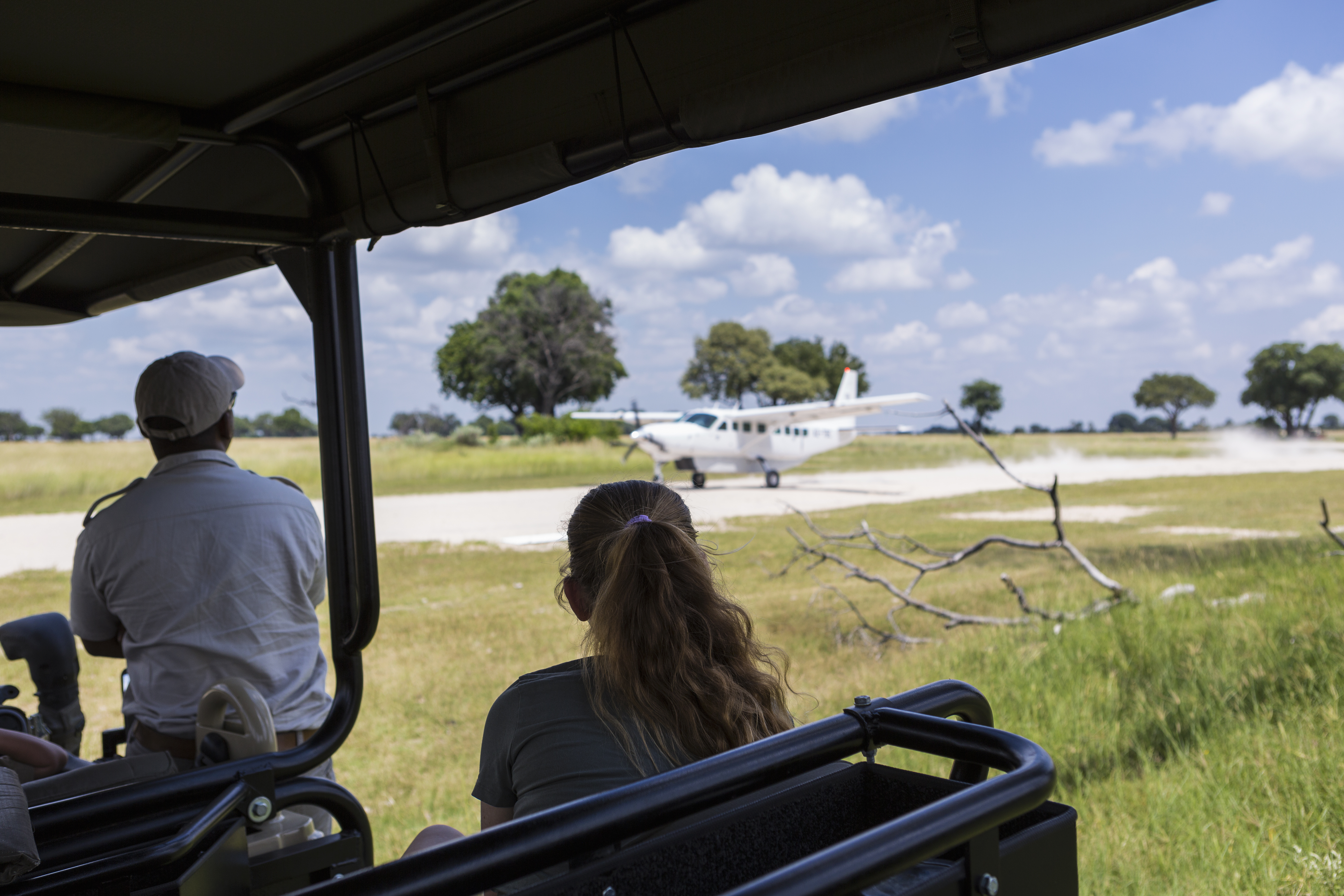
Kilimanjaro airport is also where the safari flying network begins. Light-aircraft carriers such as Coastal Aviation, Auric Air and Regional Air, along with Precision Air's larger turboprops, connect JRO and nearby Arusha Airport with the Serengeti's airstrips, Lake Manyara, and onwards to Zanzibar and Dar es Salaam. A morning arrival on Qatar can, in principle, connect to an afternoon bush flight and put you in the Serengeti for sundowners — a spectacular start, though we usually counsel a night's rest first unless your schedule is genuinely tight.
One detail catches people out: Arusha Airport (code ARK) is a separate small airfield on the west side of Arusha town, an hour's drive from JRO, and many scheduled bush flights depart from there rather than from Kilimanjaro. Booking a park flight from the wrong airport is one of the most common self-planned mistakes we see. When Sokwe builds a fly-in safari we sequence the airports, the luggage limits — soft bags, typically 15 kilograms on light aircraft — and the connection times for you, so the whole chain from long-haul arrival to bush airstrip simply works.
Your next step
Landing at Kilimanjaro and planning what comes next? Start here:
- What an all-inclusive Tanzania safari covers
- The best luxury safari lodges in the Serengeti and Ngorongoro
Or tell us your dates and what you want from the trip and our Arusha team will reply with a tailored proposal, usually within 24 hours — contact Sokwe Africa Safaris.
See also our guide: Gran Meliá Arusha: the safari gateway hotel explained.
If you are planning this route, read Which airport should you fly into for a Serengeti safari? Kilimanjaro, Arusha, Dar es Salaam and the airstrips.
See also our guide: Tanzania SIM card and eSIM guide for visitors: which network, how to register and what coverage to expect.
Departure day: leaving through JRO
Departures deserve a brief word, because the same small-airport character applies in reverse. Check-in counters open about three hours before long-haul flights and queues build quickly when the KLM and Qatar departures overlap, so we schedule guests to arrive two and a half to three hours ahead. There is a modest selection of cafés and souvenir shops after security — decent coffee, Tanzanite jewellers, carvings — but this is not an airport to plan a long, entertained wait in. Spend your last hours at a day room or lunch in Arusha instead, and time the drive accordingly.
If your safari ends deep in the Serengeti, remember that getting back to JRO takes either a full day's drive or a morning bush flight, and international check-in deadlines are unforgiving. We always build a sensible buffer into final-day logistics — usually a flight from the Serengeti to Kilimanjaro or Arusha with hours to spare, sometimes with a farewell lunch — because a missed intercontinental flight is the one mistake a safari cannot recover from. It is unglamorous planning, but it is exactly the kind of detail that separates a smooth trip from a stressful one.
Land, look for your name board, and relax
Kilimanjaro International Airport is small, friendly and easily mastered with a little preparation: book a sensible flight, sort the e-visa early, carry some US dollars, plan a first night in Arusha or Moshi, and have your transfer arranged before you land. Every Sokwe Africa Safaris itinerary includes exactly that — airport pickup with a name board, the first-night lodge, and every connection through to the parks — so your only job on arrival is to walk out of the terminal and into the start of the trip. Tell us your dates and we will plan everything from the moment your wheels touch Tanzanian soil.
Plan your Tanzania arrival and safari with Sokwe Africa Safaris