
Why Italy is one of Europe's easiest launchpads
Planning a Tanzania safari from Italy is easier than most Italian travellers expect, and considerably easier than it is from many other European countries. Italy has unusually good access to East Africa: seasonal direct services from Milan Malpensa to Zanzibar and Kilimanjaro, plus a dense web of one-stop connections through Istanbul, Doha and Addis Ababa from both Malpensa and Rome Fiumicino. Add to that a holiday calendar that happens to peak in August, exactly when the wildebeest migration is at its most dramatic in the northern Serengeti, and the practical case for going is strong.
We are Sokwe Africa Safaris, based in Arusha at the foot of Mount Meru, and we meet Italian guests at Kilimanjaro almost every week of the season. This guide sets out what actually matters when you plan from Italy: which airlines fly, what the routes cost in euros, how flight times and connections really work, how the Italian holiday windows of August, Christmas and Easter map onto Tanzania's seasons, what the e-visa involves for an Italian passport, and how honest we can be about Italian-speaking guides. It is written in English for Italian travellers who search in both languages.
Direct and connecting routes from Milan and Rome
The headline for anyone searching safari Tanzania dall'Italia is Neos, the Italian leisure carrier that operates seasonal long-haul services from Milan Malpensa to Zanzibar, and at times to Kilimanjaro as well. These are charter-style scheduled flights sold both as seat-only and as part of tour packages, and they run to a seasonal timetable rather than year-round, typically concentrated on the Italian winter and the summer holiday peak. Frequencies and the Kilimanjaro leg change from season to season, so always check the current schedule for your travel dates before you commit to any land arrangements.
If the direct flights do not fit your dates, the one-stop options are excellent. Turkish Airlines connects both Malpensa and Fiumicino through Istanbul to Kilimanjaro and Zanzibar, Qatar Airways routes through Doha, Ethiopian Airlines through Addis Ababa, and KLM and Air France offer Amsterdam and Paris connections onward to Kilimanjaro. Between them there is a workable Milan to Kilimanjaro or Rome to Kilimanjaro itinerary almost every day of the year. Ethiopian and Turkish are usually the cheapest, Qatar the most comfortable, KLM often the smoothest for morning arrivals.
Flight times, fares in euros and when to book
Timings are genuinely civilised. The direct Milan to Zanzibar service is roughly eight and a half to nine hours in the air, so you leave Malpensa and land the same day. A one-stop routing runs about three hours to Istanbul or six to Doha, then a further six to eight hours south, giving a total elapsed journey of around thirteen to seventeen hours including the connection. Many Gulf and Istanbul services arrive at Kilimanjaro in the evening, which means a first night in Arusha rather than driving straight into a park.
On fares, treat these as planning bands rather than quotes. Outside peak weeks, a one-stop economy return from Milan or Rome to Kilimanjaro typically sits somewhere around €550 to €900. In August, at Christmas and over Easter the same seats commonly run €900 to €1,300, occasionally higher on the busiest dates. Seat-only fares on the seasonal direct flights italy to zanzibar services usually land in a similar band, with the convenience premium offset by the lack of a connection. Business class from Italy generally starts around €2,000 and climbs well beyond €3,500 in peak season.
The booking rhythm that works best is to fix your safari dates first and buy the flights second, but not to leave the flights long. For August travel we ask guests to talk to us by January or February, because the camps in the northern Serengeti that put you within reach of the Mara River crossings sell out before the airfares peak. For green-season travel in March, April or May you can be far more relaxed, and last-minute fares from Italy in those months are often the best value of the year.
August, Ferragosto and the migration: a lucky overlap
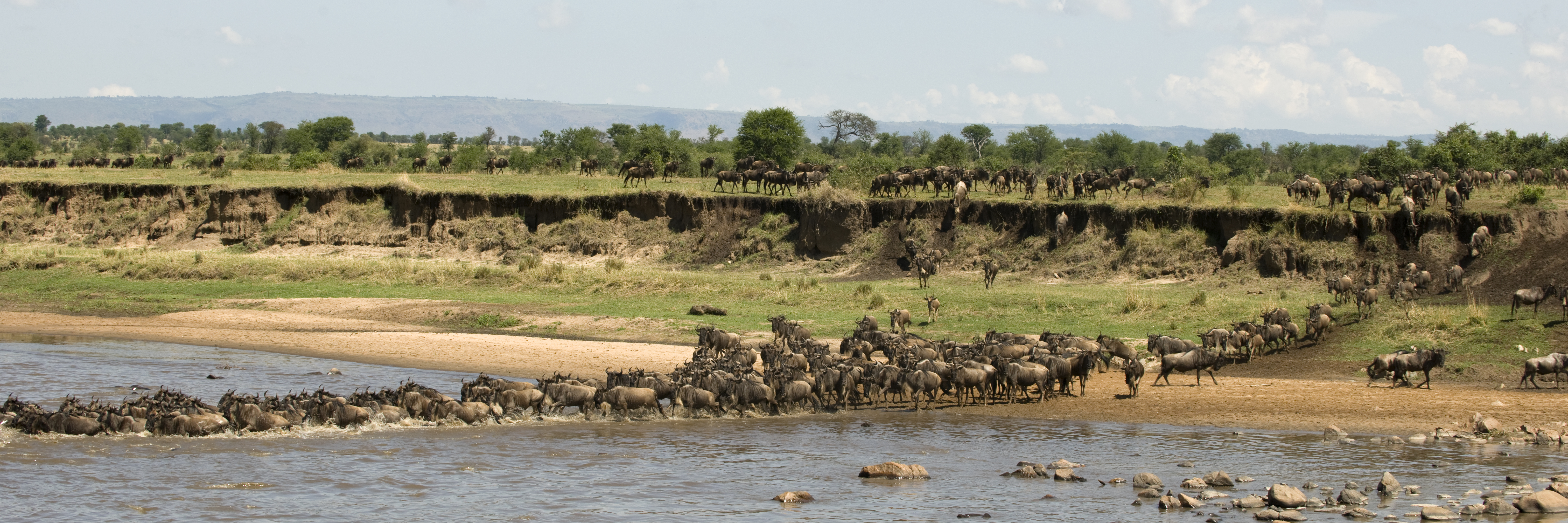
Here is the happy accident that makes a Tanzania safari from Italy so appealing. The Italian holiday calendar empties the cities around Ferragosto in mid-August, and August is one of the two or three finest months of the entire year to be in the Serengeti. The dry season is well established, the grass is short, water is scarce and predictable, and the migration herds are concentrated in the northern Serengeti along the Mara River, where the crossings happen. Most European destinations are at their most crowded and expensive in August; Tanzania in August is simply at its best.
Be clear-eyed about what that means in practice. August is high season in Tanzania too, so camp rates are at their peak and the good northern Serengeti properties are booked many months ahead. River crossings are unpredictable by nature — herds mass on the bank for hours or days before committing, and no operator can promise you a crossing on a given morning. What we can do is put you in the right part of the park for three or four nights rather than one, which is what turns a hopeful visit into a likely one.
Christmas, Easter and the other Italian windows
If August does not suit, the other Italian holiday periods work well in their own ways. Late December and early January are excellent: the short rains have usually passed, the country is green and photogenic, and the migration herds are moving south towards the Ndutu plains. The festive fortnight carries a peak-season surcharge at most camps and needs booking even earlier than August, often eight to ten months ahead, but the game viewing is superb and the light after the short rains is the best of the year for photography.
Easter falls at the start of the long rains, which is the honest weak spot in the calendar. April and May bring heavy afternoon downpours, some camps close entirely, and black cotton soil makes parts of the Serengeti hard going. In exchange you get the lowest rates of the year, dramatic skies, newborn animals and almost no other vehicles. February half-term, by contrast, is quietly one of the best-kept secrets: the calving season on the southern Serengeti plains delivers extraordinary predator activity, and Italian schools break at exactly the right moment.
Entry, e-visa and practicalities for Italian passports
Italian passport holders need a visa for Tanzania, and the sensible route is the online e-visa applied for through the official immigration portal well before departure. The ordinary tourist visa costs USD 50 for Italian citizens, is single entry and valid for up to ninety days, and is paid by card in dollars. Apply at least three weeks ahead; approvals are often faster but the portal can be slow in peak periods. Print the approval and carry it with you, because airline check-in staff at Malpensa and Fiumicino routinely ask to see it before boarding.
A few other practicalities. Your passport needs six months of validity beyond arrival and at least one blank page. Yellow fever vaccination is only required if you are arriving from or transiting a country with risk of transmission, which does not apply to a direct flight from Italy, but it can apply on some African routings — check your specific itinerary. Malaria prophylaxis is strongly advised for the parks and Zanzibar alike, and travel insurance with medical evacuation cover is not optional in our view.
What a Tanzania safari costs in euros
Safari pricing in Tanzania is quoted in US dollars, because park fees, camp rates and vehicle costs are all dollar-denominated, so your final euro cost moves with the exchange rate. As a planning guide, a comfortable mid-range safari on the northern circuit with a private vehicle and guide works out at roughly €350 to €500 per person per day, all-inclusive on the ground. A genuinely luxury safari with small tented camps in prime locations runs about €600 to €900 per person per day, and the ultra-luxury tier climbs beyond €1,000.
Those figures include park entry fees, which are substantial and often surprise first-time visitors. Serengeti entry runs around USD 70 to 80 per adult per day, and the Ngorongoro Crater carries both a per-person conservation fee and a separate crater descent charge for the vehicle. Together, fees alone can account for a quarter of the daily cost of a northern circuit safari. A typical seven-night safari from Italy for two people, with international flights, mid-range camps and a private vehicle, therefore lands somewhere around €7,000 to €10,000 in total.
Italian-speaking guides: the honest answer
We will be straightforward here, because it matters. Tanzania's professional guides work in English and Swahili, and the pool of genuinely fluent Italian speakers across the northern circuit is small — perhaps a few dozen, most booked well ahead by the Italian tour operators. We can often secure one with enough notice, and we will say plainly if we cannot for your dates. What we will not do is put you with a guide whose Italian is weak and let you discover it on day one.
Why Italians pair safari with Zanzibar
More than any other European market, Italian travellers combine the bush with the beach, and the geography rewards it. Zanzibar has been an Italian holiday favourite for decades, the seasonal Malpensa services fly there directly, and a domestic hop from the Serengeti or Arusha to the island takes little more than an hour. The rhythm suits the way Italians travel: an intense, early-rising week of game drives, then five or six days of doing very little at all on the east coast, with excellent food and a genuinely relaxed pace.
The practical structure we recommend is safari first, beach second, always. Coming off a dawn game drive into a Zanzibar sunlounger is one of travel's great transitions, and doing it the other way round wastes the beach on jet lag. Seven nights on the northern circuit followed by five or six on the island fits neatly into the Italian August window and returns you to Malpensa or Fiumicino on a Sunday. If you have less time, five safari nights and four on Zanzibar still works, though it is a brisker trip.
See also our guide to Italian-speaking safari guides.
See also our guide: Tanzania safari from Germany: flights, costs and planning.
Most of Europe travels in August and pays for the privilege. Italians travelling to Tanzania in August get the single best month of the migration year — that is a rare piece of luck.
- Seasonal Neos direct flights from Milan Malpensa to Zanzibar and Kilimanjaro
- Daily one-stop options via Istanbul, Doha, Addis Ababa, Amsterdam and Paris
- Economy returns roughly €550–€900, rising to €900–€1,300 in peak weeks
- August and Ferragosto coincide with the northern Serengeti river crossings
- E-visa for Italian passports, USD 50, apply at least three weeks ahead
- Safari on the ground roughly €350–€900 per person per day depending on standard
- Safari first, Zanzibar second — always in that order
Sample routings from Italy
A ten-night August trip from Milan works like this. Fly Malpensa to Kilimanjaro on the Saturday, overnight in Arusha, then head to Tarangire for two nights among the baobabs and elephant herds. Continue to the Ngorongoro Crater rim for a night and a full crater morning, then fly into the northern Serengeti for four nights positioned for the Mara River. Fly out to Zanzibar for three or four nights on the east coast, and return to Malpensa direct or via Doha. It is a full, unhurried itinerary that uses every day well.
For a shorter break from Rome, an eight-night version works well: Fiumicino to Kilimanjaro via Istanbul overnight, a night in Arusha, three nights in the central Serengeti, one on the crater rim, and three on Zanzibar. For a green-season trip in February, swap the northern Serengeti for the Ndutu plains and the calving herds — the same length of trip, roughly a third less on camp rates, and predator sightings that many of our repeat guests rate above the crossings.
Plan your Tanzania safari from Italy
Italy's combination of direct seasonal flights, strong one-stop connections and an August holiday window that lands on the best weeks of the migration makes a Tanzania safari from Italy unusually straightforward to organise — as long as you start early enough. Planning from Italy? Tell us your August dates early, because the migration weeks book out first, and the northern Serengeti camps go long before the airfares do. Send us your dates, your budget in euros and whether you want Zanzibar on the end, and we will build the trip around them.
Plan your Tanzania safari from Italy with Sokwe Africa Safaris