
Tanzania's elephant capital
Ask any Tanzanian guide which national park Tarangire most resembles and you will get a pause, because the honest answer is none of them. Tarangire National Park is northern Tanzania's elephant capital: a landscape of ancient baobabs and golden grassland where, in the dry season, herds several hundred strong file down to a single life-giving river. It sits barely two and a half hours from Arusha, yet it delivers some of the most concentrated game viewing in East Africa, and it remains curiously underrated beside its famous neighbours the Serengeti and the Ngorongoro Crater.
This is our reference guide to the park itself — the essential facts, the river that drives everything, the elephants, the baobabs, the honest truth about seasonality, the practicalities of fees and drive times, and where Tarangire slots into the classic northern-circuit route. If you are after the experience side — what a day on safari here actually feels like, and which camps we rate — read this alongside our companion piece on the Tarangire safari itself, which we link further down.
The essential facts: size, location and the river
Tarangire National Park covers roughly 2,850 square kilometres of northern Tanzania, making it the sixth-largest national park in the country — about half the size of the Serengeti, but far larger than Lake Manyara or the Ngorongoro Crater floor. It lies around 120 kilometres south-west of Arusha, just off the main tarmac road that carries safari traffic towards Manyara and the crater, which is precisely why it makes such a natural first or last stop on a northern safari.
The park is named for the Tarangire River, and the river is the key to understanding everything about the place. It is a modest, meandering watercourse for much of the year, but it is perennial — it keeps flowing, or at least holding water in pools and sand, right through the long dry months when almost every other water source in this corner of the Maasai steppe fails. Add the great Silale, Gursi and Larmakau swamps in the park's south, which act as vast green sponges, and you have a dry-season refuge for wildlife across an ecosystem many times the park's own size.
Why Tarangire is the elephant capital of the north
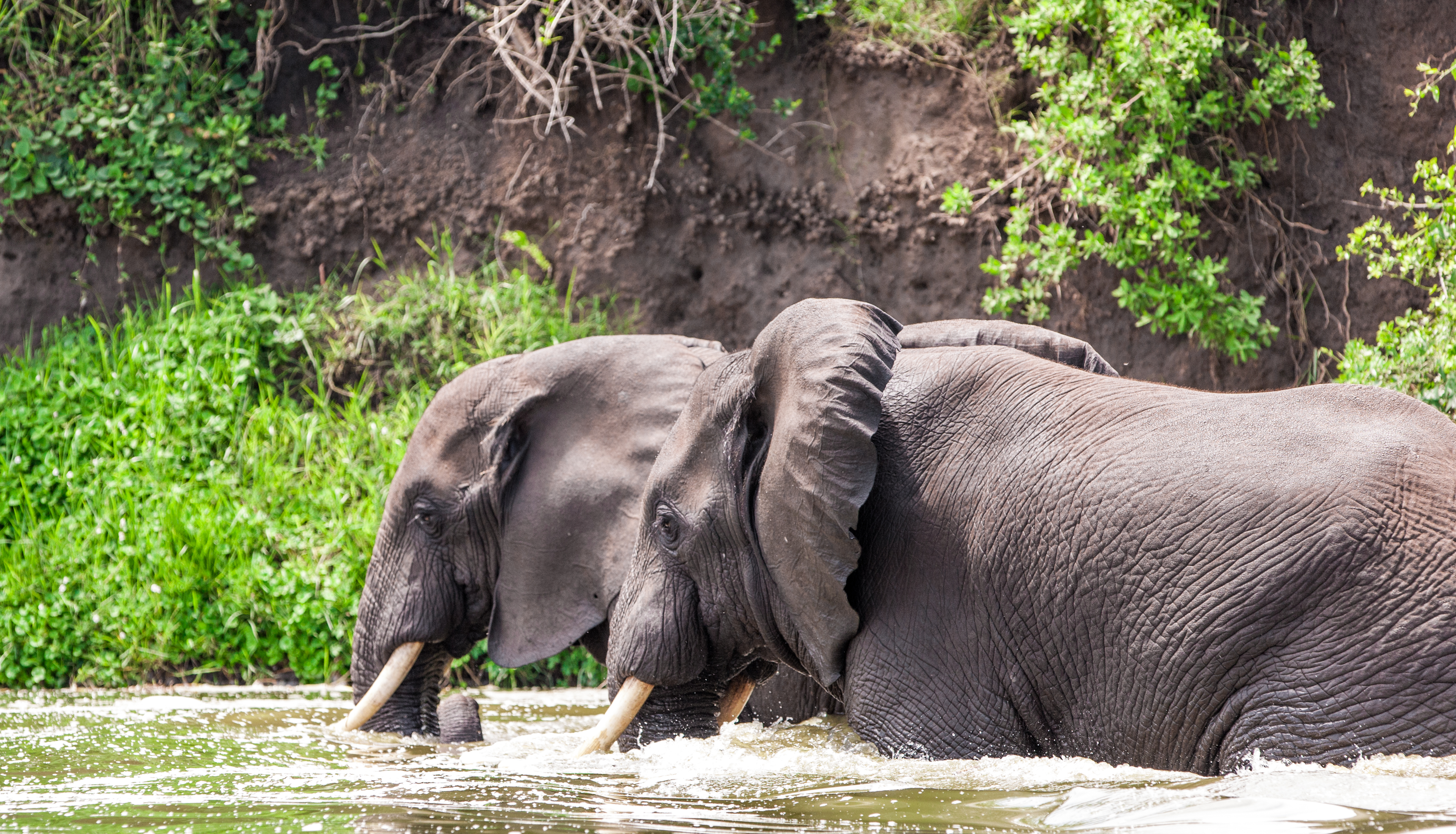
Tarangire holds one of the densest elephant populations anywhere in Tanzania, with several thousand elephants using the greater ecosystem. In the dry season they gather along the river in herds that genuinely reach 300 animals — breeding herds merging with bachelor groups until whole hillsides seem to move. Nowhere else on the northern circuit will you sit among so many elephants at such close, relaxed quarters, and for many of our guests it is the single most powerful memory of their entire safari.
What makes the viewing so good is not just the numbers but the behaviour. Tarangire's elephants dig wells in the dry riverbed with their feet and trunks, drawing up clean water that then sustains zebra, impala and baboons after they move on. You watch matriarchs marshal crossings, calves flounder up sandy banks, and young bulls spar in the shallows — hours of unforced natural theatre. The park's elephants are famously calm around vehicles, having been studied and protected here for decades, which means close sightings without stress on either side.
The baobab landscape
If elephants are Tarangire's signature animal, the baobab is its signature tree. The park is scattered with thousands of these giants, some believed to be well over a thousand years old, their swollen silver trunks and crooked bare branches giving the landscape a character found nowhere else on the northern circuit. Elephants strip the fibrous bark for moisture in the driest months, leaving many trunks polished and gouged — a living record of the relationship between the park's two great icons.
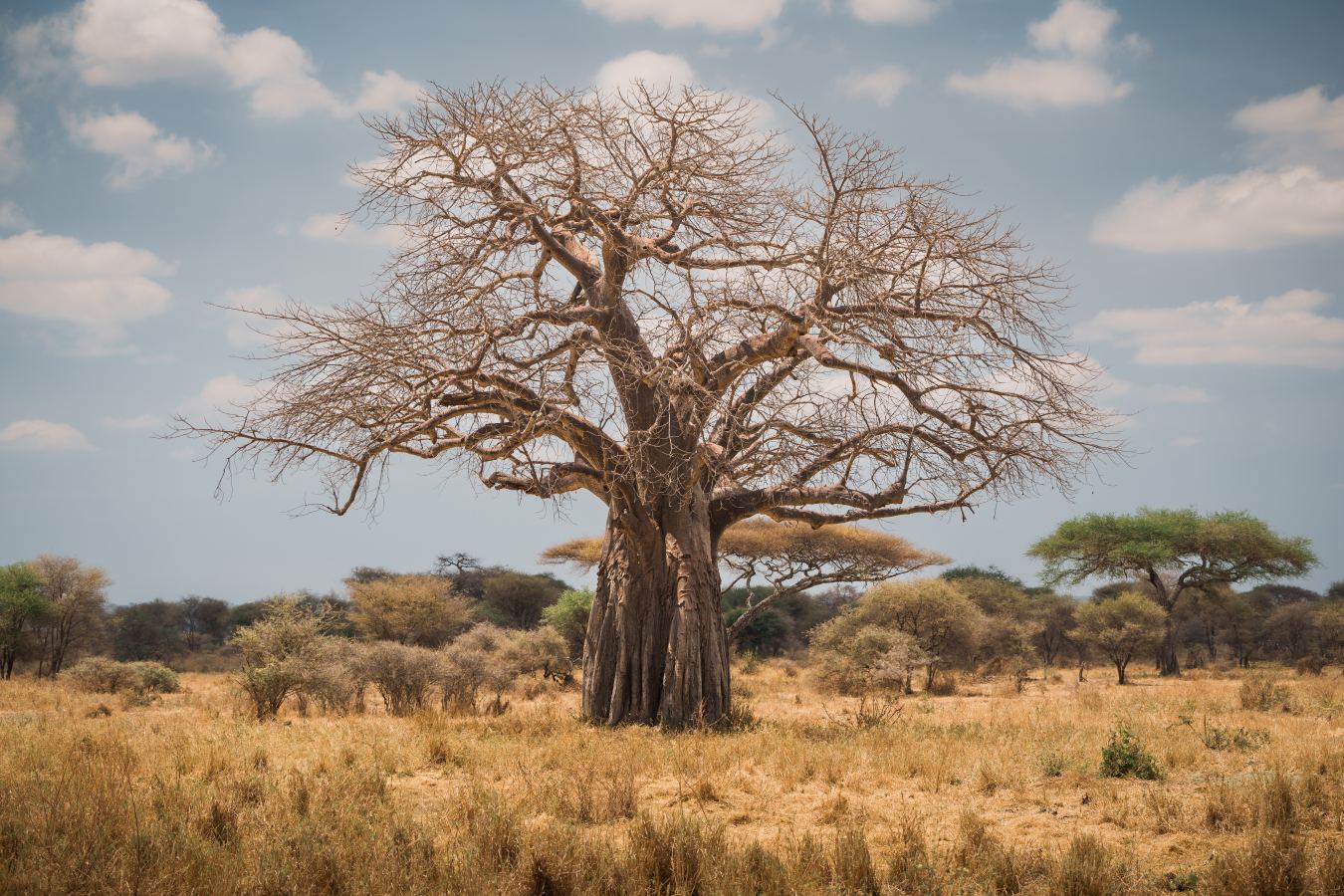
For photographers the baobab country is a gift. Where the Serengeti is about horizons and the crater is about the caldera walls, Tarangire is about foregrounds: a herd of elephants dwarfed by a two-thousand-year-old tree, a lion resting in root shade, a sunset silhouette that needs no filter. The light in the first and last hours of the day, when dust hangs golden over the river valleys, is as good as any we know in Tanzania, and the rolling terrain means fresh compositions around every bend.
Seasonality, explained honestly
Tarangire is the most strongly seasonal park on the northern circuit, and you deserve a straight answer about what that means. From June to October, and often into November, the dry season transforms it into one of the great wildlife spectacles in Africa: as outside water sources fail, elephants, zebra, wildebeest, buffalo and eland pour into the park and concentrate along the river and swamps. Migration studies suggest Tarangire hosts one of the largest dry-season concentrations of wildlife in the country outside the Serengeti. In these months, game viewing here is world class by any standard.
In the green season, roughly December to May, much of that wildlife disperses out onto the surrounding Maasai steppe to feed on fresh grazing, and game viewing becomes quieter — still rewarding, with resident elephants, big cats and superb birding in lush, dramatic scenery, but not the extraordinary density of September. We say this plainly because it shapes planning: in the dry season Tarangire deserves a starring role and two nights; in the green season it works better as a scenic, uncrowded one-day chapter at lower lodge rates, with expectations set accordingly.
In the dry season, Tarangire is not a warm-up act for the Serengeti — it is one of the great elephant spectacles on Earth, two and a half hours from Arusha.
Wildlife beyond the elephants
Tarangire is far more than an elephant park. Lions are seen daily along the river circuits, leopards favour the sausage trees and rocky ridges, and cheetah work the open south of the park. The general game is excellent in season — buffalo, giraffe, zebra, wildebeest, hartebeest and waterbuck in numbers — and Tarangire offers dry-country specials that the Serengeti does not, most notably the shy and beautiful lesser kudu, along with fringe-eared oryx and gerenuk in the remoter reaches. Pythons famously, if infrequently, drape themselves in trees near the swamps.
Birders should plan extra time here, because Tarangire's list runs to more than 500 species — among the richest of any Tanzanian park. The swamps hold storks, herons and huge flocks of waterfowl; the grasslands are strutted by kori bustards and ostrich; and the acacia country produces the yellow-collared lovebird and ashy starling, both effectively endemic to this ecosystem. Even on a game drive focused on elephants, the constant birdlife gives Tarangire a busy, living texture that guests notice immediately.
Fees, drive times and practicalities
Getting here is refreshingly easy. From Arusha it is around two to two and a half hours' drive, almost all on good tarmac, to the main gate — close enough that a dawn departure has you watching elephants by mid-morning. Entry for non-resident adults is in the region of USD 50–60 per 24 hours plus 18 per cent VAT, with vehicle and concession fees on top depending on where you stay; fees are paid electronically through your operator rather than in cash at the gate. For current figures across every park, see our fees guide linked below.
A few practical notes worth knowing. The park operates a 24-hour permit system, so a well-planned two-day visit can make one fee stretch across two game-driving days. The main game-viewing network centres on the river circuits in the north of the park, within easy reach of the gate, while the southern swamps reward those staying deeper inside. Roads are good by park standards but corrugated in places; a proper 4x4 with an experienced driver-guide, which is how all Sokwe safaris travel, makes the difference between a long day and a comfortable one.
One day or two?
The most common question we are asked about Tarangire in the flesh is whether it deserves one day or two, and the answer depends on season and appetite. A single full day, done properly — through the gate at opening, picnic lunch by the river, out at dusk — gives you the essential Tarangire: the elephant herds, the baobabs, very likely lions, and a genuine sense of the place. In the green season, or on a tightly scheduled circuit, one day is a fair allocation.
In the dry season, two days repay themselves handsomely. A second day lets you push south to the Silale swamps, where the elephant concentrations and birdlife peak and vehicle numbers thin dramatically, and it lets you slow down — to sit with a single herd for an hour rather than ticking sightings. Staying inside the park or on its boundary means you are on the river at first light, when the animals are most active and the light is at its best, instead of arriving mid-morning with the day-trip traffic from Arusha.
Where Tarangire fits in the northern circuit
Tarangire's position makes it the natural opening chapter of the classic northern circuit. The time-honoured route runs Arusha to Tarangire for a night or two, then on to the Ngorongoro Crater, and finally into the Serengeti before flying or driving back — a sequence that builds beautifully, from intimate elephant encounters under the baobabs to the crater's amphitheatre and then the endless plains. Because it lies right on the route, Tarangire adds depth to a safari at very little cost in driving time.
It also plays well in shorter itineraries. Combined with the Ngorongoro Crater it makes an outstanding three- to four-day safari for travellers short on time, and as a standalone two-day trip from Arusha it is, for our money, the best-value big-game experience in the north. If you are weighing it against the flagship park, our Serengeti reference guide makes a useful comparison — the two parks complement rather than compete, which is exactly why the classic circuit includes both. Browse our ready-made itineraries to see how we typically sequence them.
Your next step
Ready to see Tarangire's elephants yourself? Start here:
Or tell us your dates and what you want from the trip and our Arusha team will reply with a tailored proposal, usually within 24 hours — contact Sokwe Africa Safaris.
Plan your safari: Tarangire safari guide · Serengeti National Park guide · park fees · safari packages · plan your safari
See also our guide: Tarangire Safari Lodge: the view that sells itself.
If you are planning this route, read Is Tarangire National Park worth visiting? Elephants, baobabs, the best season and who it suits.
- 2,850 km² — Tanzania's sixth-largest national park
- Perennial Tarangire River drives dry-season concentrations
- Elephant herds up to 300 strong, June–October
- Thousands of ancient baobabs, some over 1,000 years old
- Lesser kudu, oryx and 500+ bird species
- 2–2.5 hours' drive from Arusha on tarmac
- Classic first stop on the northern circuit
When to book and what it costs to do well
For a dry-season visit, book early: the small camps inside the park and the best lodges on its fringes fill months ahead for July to October, and the difference between a good room and the right room is real here. Budget-wise, Tarangire is one of the more accessible parks to do well, because its proximity to Arusha keeps transfer costs down and its lodge range runs from honest mid-range to genuinely lovely tented camps. The green season brings meaningful discounts at many properties, which is part of the case for travelling then.
The other thing worth booking carefully is the guiding. Tarangire rewards guides who know the river circuits intimately — where the herds cross at which hour, which swamps are holding elephants this week, where the lions denned this season. That local knowledge is the difference between seeing Tarangire and merely driving through it, and it is precisely what a small Arusha-based operator lives and breathes in a park this close to home.
Let us show you the elephants properly
Tarangire National Park is two and a half hours from our door in Arusha, and it is the park we know best of all — our guides are on its river circuits week in, week out, in every season. Whether you want it as the opening act of a full northern circuit, a short crater-and-Tarangire escape, or a two-day elephant immersion in its own right, tell us your dates and we will build it around the herds. Get in touch and let us show you the elephants properly.
Plan your Tarangire safari with Sokwe Africa Safaris
Frequently asked questions
Why is Tarangire famous?
Tarangire is northern Tanzania's elephant capital. In the dry season, herds that genuinely reach 300 animals file down to the perennial Tarangire River, and the park is scattered with thousands of ancient baobabs, some well over a thousand years old. Add lesser kudu, fringe-eared oryx and more than 500 bird species and you have a landscape found nowhere else on the circuit.
How far is Tarangire from Arusha?
Around 120 kilometres south-west, which is roughly two to two and a half hours' drive to the main gate, almost all of it on good tarmac. A dawn departure from Arusha has you watching elephants by mid-morning. That proximity is exactly why Tarangire makes such a natural first or last stop on a northern safari.
How big is Tarangire National Park?
Tarangire covers roughly 2,850 square kilometres, making it Tanzania's sixth-largest national park, about half the size of the Serengeti but far larger than Lake Manyara or the Ngorongoro Crater floor. The main game-viewing network follows the river circuits in the north, while the great Silale, Gursi and Larmakau swamps lie in the quieter south.
How much are Tarangire park fees?
Entry for non-resident adults is in the region of USD 50 to 60 per 24 hours plus 18 per cent VAT, with vehicle and concession fees on top depending on where you stay. Fees are paid electronically through your operator rather than in cash at the gate, and the 24-hour permit can stretch across two game-driving days.
How many days do you need in Tarangire?
A single full day, through the gate at opening and out at dusk, gives you the essential park: elephant herds, baobabs and very likely lions. In the dry season two days repay themselves handsomely, letting you push south to the Silale swamps where the elephant concentrations and birdlife peak and vehicle numbers thin dramatically.
When is the best time to visit Tarangire National Park?
June to October, and often into November, is the park at its peak: as outside water sources fail, elephant, zebra, wildebeest, buffalo and eland pour in and concentrate along the river and swamps. From December to May much of that game disperses onto the Maasai steppe, leaving quieter but lush, uncrowded viewing at lower lodge rates.